
Every Member is Already a Missionary! But What Are They a Missionary For?
Growing up I heard the call "Every member a missionary!" I thought that was the goal of the Church: to help every member become a missionary. But, this past week I had an epiphany. I was listening to Elder Groberg relate a story of getting on an airplane and the man next to him asking what he did for work? He explained to the man that he was a missionary. The man in disgust said that he hated missionaries. Elder Groberg rebutted, but you are a missionary!?! The man denied the accusation and asked why Elder Groberg would've made it. Elder Groberg explained that his words and actions were an influence on others, that he was a missionary for his way of life. For example, he told the man, you have cigarettes in your pocket. You believe in smoking. You are doing the missionary work for the tobacco people.
This story hit home for me and I've been pondering on this concept for a few days. It hit me. Every single one of us is already a missionary. But what are we a missionary for? What organization, cause, or movement are we evangelizing in our day-to-day interactions with others? What causes are our influence and money being used to advocate? I want to highlight 4 types of missionaries that people often are.
1st. Missionaries of Political Parties.
For many people, their political party comes first. They will deny this, but if you look at their words and their actions it shows that for them, their political party comes before God, Family, Friends, and often even the very nation they live in. For many people, they justify this by claiming that their political party is right, and that "Jesus would be a Republican" or "Jesus is a Socialist." They quote scriptures to justify their positions but when the Prophet denounces something their party supports they either ignore him or tell him to shut up and sit down.
Heber J. Grant, when he was the Prophet, told the Saints not to vote in favor of repealing Prohibition. Not only did they disregard President Grant's counsel, but Utah actually cast the deciding vote that ended prohibition. President Grant lamented that some members sang “We Thank Thee, O God, for a Prophet” seemed to add the words, “provided he keeps his mouth shut politically.”
The God of Heaven and Earth, even Jesus Christ, is NOT a Republican nor is He a Democrat. Nor is He a libertarian. For more on this topic, or if you disagree and think Jesus is a republican or democrat, see this article "Jesus is not a Republican or a Democrat, so stop trying to make him one!"
2nd. Missionaries of Ideologies.
Similar to those, who by their words and actions, evangelize political parties, many people evangelize their ideologies. For example, on Social Media there are many people who only post or talk about Critical Race Theory (CRT), they might be for, or against it. But they are full-time social media missionaries for the cause. Other ideological causes that many are missionaries for include those who are Anti/Pro masks or medical treatments. Those who are Anti/Pro-Capitlaistism/Socialism. Feminism, liberalism, conservativism, environmentalism, intellectualism, Etc, Etc, etc.
Of Ideologies, President Dallin H. Oaks has taught, "Those who govern their thoughts and actions solely by the principles of liberalism or conservatism or intellectualism cannot be expected to agree with all of the teachings of the gospel of Jesus Christ. As for me, I find some wisdom in liberalism, some wisdom in conservatism, and much truth in intellectualism—but I find no salvation in any of them."
When your friends know you for the causes you fight for, over the religion you adhere to, your causes have become a false god and you are an ideological missionary of it.
3rd. Missionaries of Principles.
The gospel is like a piano keyboard. The keys are the different principles of the gospel. Whereas loving a principle is not bad, we must always keep that principle or 'key' in the context of the full gospel piano. Missionaries of principles are those who insistently pound their favorite key, insisting that it is the most important key on the gospel keyboard. They take a principle that is true, and important, and they pull it out of the context and its proper place to the point that they evangelize the principle at the expense of the gospel.
You have seen this with members who miss the mark by pounding their hobby key of food storage, word of wisdom, or even something as important as missionary work, family history, or temple work. Often they pound their key and get contentious if someone tries to advocate any other key on the keyboard, because 'their key' and their interpretation is the most important part of the gospel! When in reality, these are merely keys on the grand gospel piano, they are NOT the entire piano themselves.
What is worse, when we develop a hobby key and it is taken out of context we can become a zealot for that principle. And we can start to twist the entire gospel out of context until we find ourselves having apostatized and criticizing our leaders for not giving our key the same priority and supremacy that we give it. Boyd K. Packer used this same analogy and warned of this when he said: "Some members of the Church who should know better pick out a hobby key or two and tap them incessantly, to the irritation of those around them. They can dull their own spiritual sensitivities. They lose track that there is a fullness of the gospel and become as individuals, like many churches have become. They may reject the fullness in preference to a favorite note. This becomes exaggerated and distorted, leading them away into apostasy."
4th. Missionaries of the Gospel.
The fourth and final type of missionary I want to talk about are missionaries of the gospel. For them, the gospel comes before all other interests and affiliations. Unlike party missionaries, when they engage in politics they ensure that their affiliation with the gospel comes first. They realize that our political philosophy becomes a false god to us when we follow it rather than the Lord and His prophets. (For more about political mistakes see "Five Major Mistakes That Latter-day Saints Make With Politics"). They realize that Jesus Christ is the King, and His word is law. They choose to align and subject themselves to Christ.
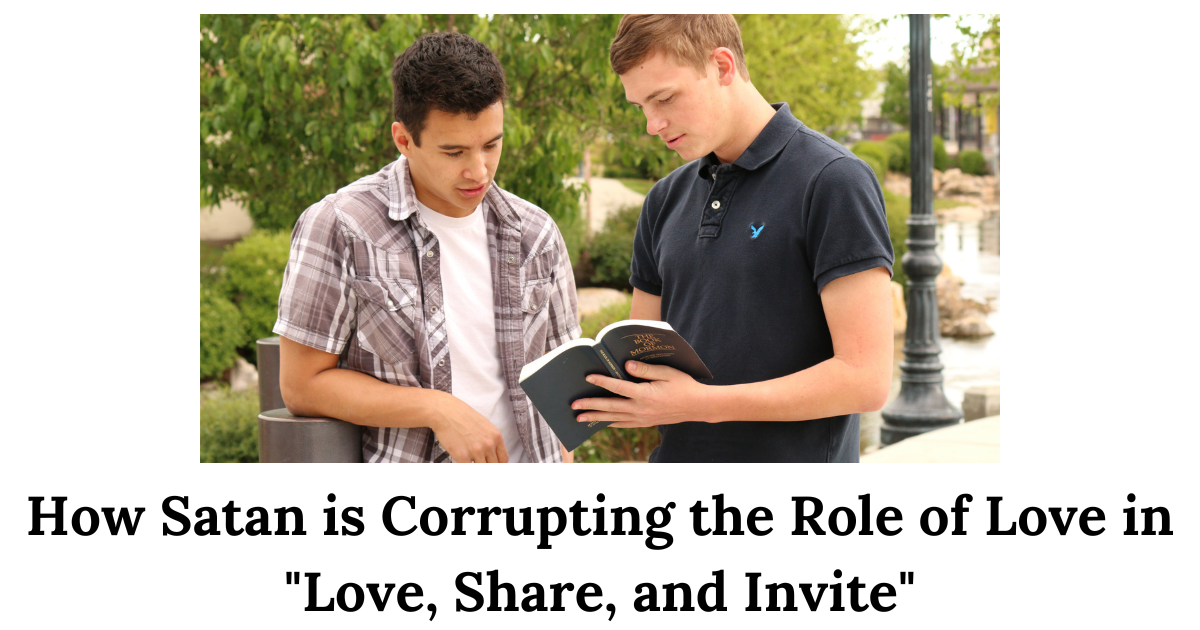
Unlike ideology missionaries, their focus is not to 'convince' others that their cause is right. Their goal is to love others, share the gospel, and invite them to come unto Christ. And unlike principle missionaries, they understand, in the words of Elder Theodore M. Burton, that "Sunday School, missionary work, priesthood, genealogy, temple work, welfare, home teaching, education, or whatever interest we have or church position we occupy at present is only part of the gospel whole." and that "An appreciation of diversification is the basis of unity." (Conference Report, October 1969 Page 34).
Missionaries of the gospel are fully converted to the gospel, they like the Son's of Mosiah, are "desirous that salvation should be declared to every creature, for they could not bear that any human soul should perish" (Mosiah 28:3). They are not preoccupied with building their own kingdom but rather building The Kingdom of God. Missionaries of the Gospel have been born again and are full of the love of God, and in the words of Joseph Smith, "A man filled with the love of God, is not content with blessing his family alone, but ranges through the whole world, anxious to bless the whole human race.”
When David O. McKay declared "Every member a missionary!" It was a prophetic call for us all to strive to be a missionary of the gospel.
Conclusion: What type of missionary are you?
The biggest question each of us must figure out is what type of missionary am I? Am I a political party missionary? Am I a missionary for an ideology or principle? Or am I a missionary of the gospel of Jesus Christ? Look at your social media posts, which is your online influence, what are they advocating? But if you want a brutally accurate analysis don't do this audit yourself, ask others what they see you advocating with your time, talents, money, and influence. But most importantly, ask the Lord. If you don't like the answer as to what type of missionary you currently are then change!
We all can do better! Let us harken to the words of Dieter F. Uchtdorf: "We must put aside our pride, see beyond our vanity, and in humility ask, “Lord, is it I?” And if the Lord’s answer happens to be “Yes, my son, there are things you must improve, things I can help you to overcome,” I pray that we will accept this answer, humbly acknowledge our sins and shortcomings, and then change our ways by becoming better husbands, better fathers, better sons [and missionaries]. May we from this time forward seek with all our might to walk steadfastly in the Savior’s blessed way—for seeing ourselves clearly is the beginning of wisdom."


Excellent piece!