Three Things You Did Not Know About The Restoration
Three Things You Did Not Know About The Restoration
The Restoration was ushered in by the First Vision in the Spring of 1820. But God started preparing the world long before 1820 for the Gospel to be restored. Here are three things you did NOT know about the Restoration.
1st. That The Founder Of The First Baptist Church In America Prepared The Way For The Restoration.

Roger Williams did more to pave the way for the Restoration than almost any other man who preceded Joseph Smith. I will not give a full history of Roger Williams; I will, however, summarize parts of Roger Williams’s life that are important in regards to the Restoration. Roger Williams was born in London England in 1603. While growing up, he became extremely religious. He followed the Puritans to Massachusetts in 1631. Because of his outspoken religious views, he gained a massive following but also upset the Puritan leadership.
In October 1635 he was convicted of sedition and heresy and banished for his religious views. He and his followers left Massachusetts in exile in the spring of 1636. They crossed over the Seekonk River and founded a new city and colony, naming it Providence Rhode Island. Roger Williams ensured that Rhode Island would be different than Massachusetts. In Rhode Island, there would be Religious Freedom, a freedom unknown by any colonist at the time.
In Rhode Island, every man would have the freedom of practicing his religion. They would be free from any state-sponsored religion or persecution. The idea was radical; every other colony had an unholy union of church and state, which union caused persecution and exile or execution of all those who were not in strict compliance with the church leaders. Rhode Island became a beacon of religious liberty.
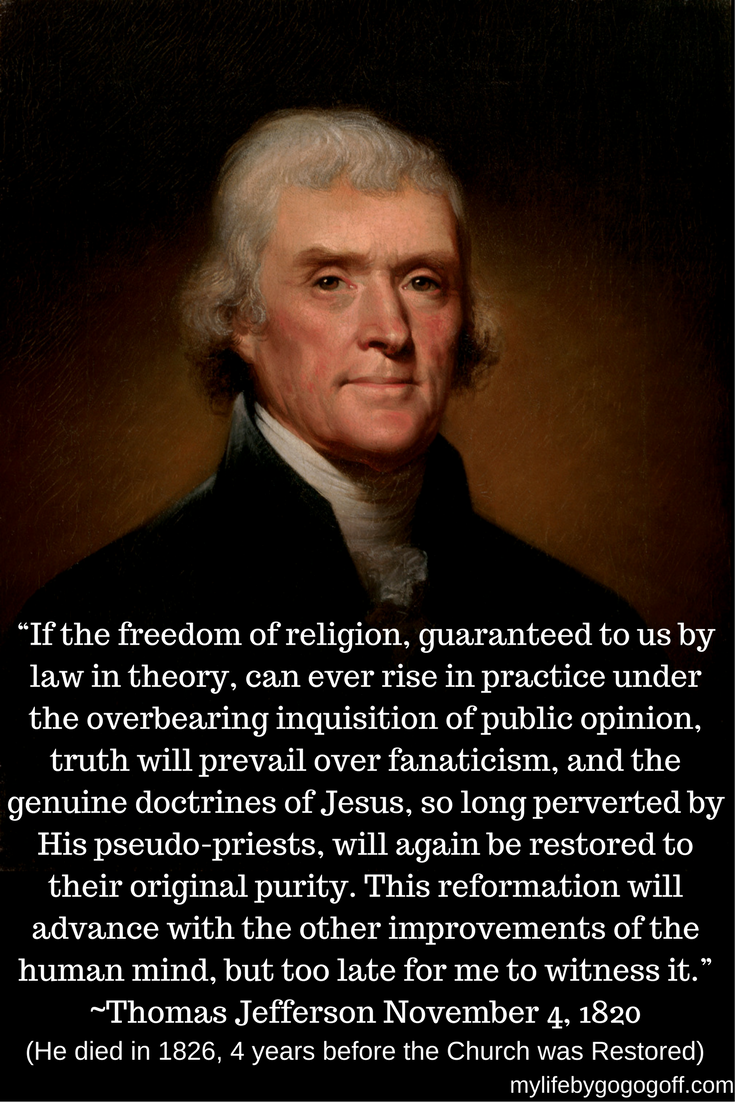
Over 100 years after his death, the framers of the United States Constitution borrowed upon the writings of Roger Williams. They included Freedom of Religion as our 1st Right in the Bill of Rights. The framers knew this would eventually lead to a restoration of truth. Thomas Jefferson wrote: “If the freedom of religion, guaranteed to us by law in theory, can ever rise in practice under the overbearing inquisition of public opinion, truth will prevail over fanaticism, and the genuine doctrines of Jesus, so long perverted by His pseudo-priests, will again be restored to their original purity. This reformation will advance with the other improvements of the human mind, but too late for me to witness it.” ~Thomas Jefferson November 4, 1820 (He died in 1826, four years before the Church was restored)
Not only is Roger Williams the Father of our First Amendment, but he is also credited with founding the First Baptist Church in America. But Roger Williams soon left the Baptist Church; he then taught the following: “The Apostasy… hath so far corrupted all, that there can be no recovery out of that apostasy until Christ shall send forth new apostles to plant churches anew.”
Roger Williams
When Roger Williams realized there had been an apostasy he left the Baptist Church and sought for restoration of Priesthood Authority, and told his followers: "There is no regularly constituted church of Christ on earth, nor any person qualified to administer any church ordinances; nor can there be until new apostles are sent by the Great Head of the Church for whose coming I am seeking."
Roger Williams
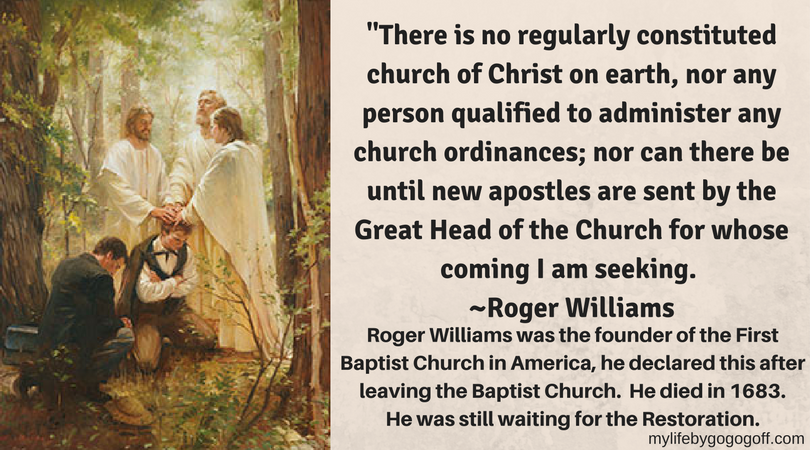
He died in 1683. He was still waiting for the Restoration. Without Roger Williams, there would be no freedom of religion. Without religious freedom, Joseph Smith never could've restored the Church on April 6th, 1830. Cool fact, his 10th Great Grandson, is Elder Jeffrey R. Holland.
2nd. How God Moved A Mountain To Move The Smith Family.
Joseph Smith Sr. married Lucy Mack in Tunbridge Vermont on January 24, 1796. In 1802 the Smiths were scammed out of over $3,000 worth of ginseng root by a local Vermonter, the Smith family lost their farm and were penniless. Over the next ten years, they moved half a dozen times. In 1814 the Smith family had moved to Norwich Vermont, the first two years they suffered crop failures, they could not afford another one.
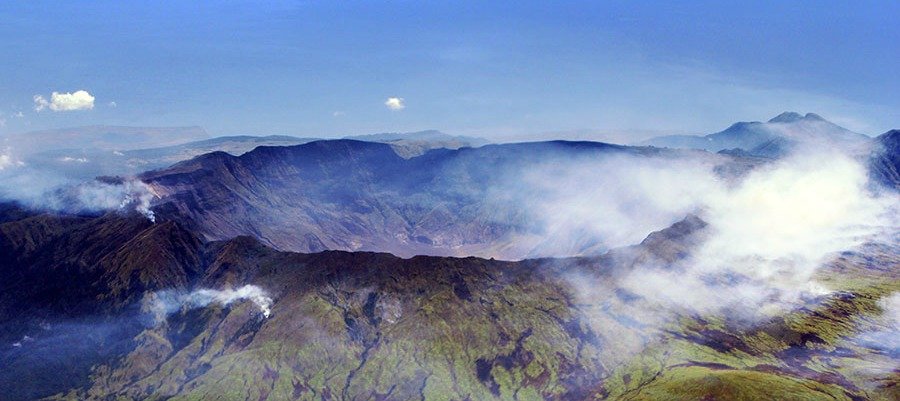
Half a world away in the East Indies, in what has been the largest volcanic eruption in recorded history Mt Tambora blew up. The ash from this eruption circled the global and caused 1816 to be known as "the year without summer." With three hard freezes during the summer of 1816, the Smith family experienced what would be their final crop failure in Vermont. Joseph Smith, Sr. hearing of fertile lands west of Vermont in New York went to upstate New York to look for property. He bought land in Palmyra and sent for his family in Vermont. The Smiths moved to Palmyra New York later that year.
3rd. The Role Of Maple Trees In The First Vision And Priesthood Restoration.
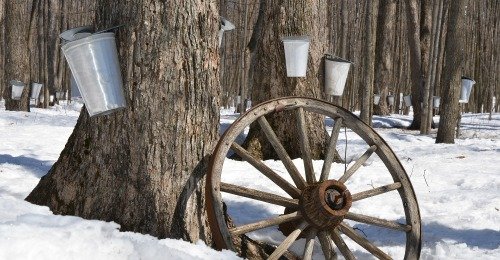
Maple trees are unique in New England. Maple sap is exceptionally high in sugar, and during the winter and spring a maple tree can be "tapped" and up 20 gallons of this sap can be collected without permanent harm to the tree. The Native Americans taught the pilgrims how to tap maple trees and then boil the sap into syrup. Ever since then the Maple Tree and Maple Syrup has become a symbol of New England. What does this have to do with the Restoration? Everything. Living in Vermont the Smith family had learned the value of Maple trees. When Joseph Smith Sr. was looking for land in New York, he doubtlessly looked for land with maple trees. He found that perfect plot of land in Palmyra; it had good soil for crops and contained a "sugar bush" or grove of 1,500 maple trees!
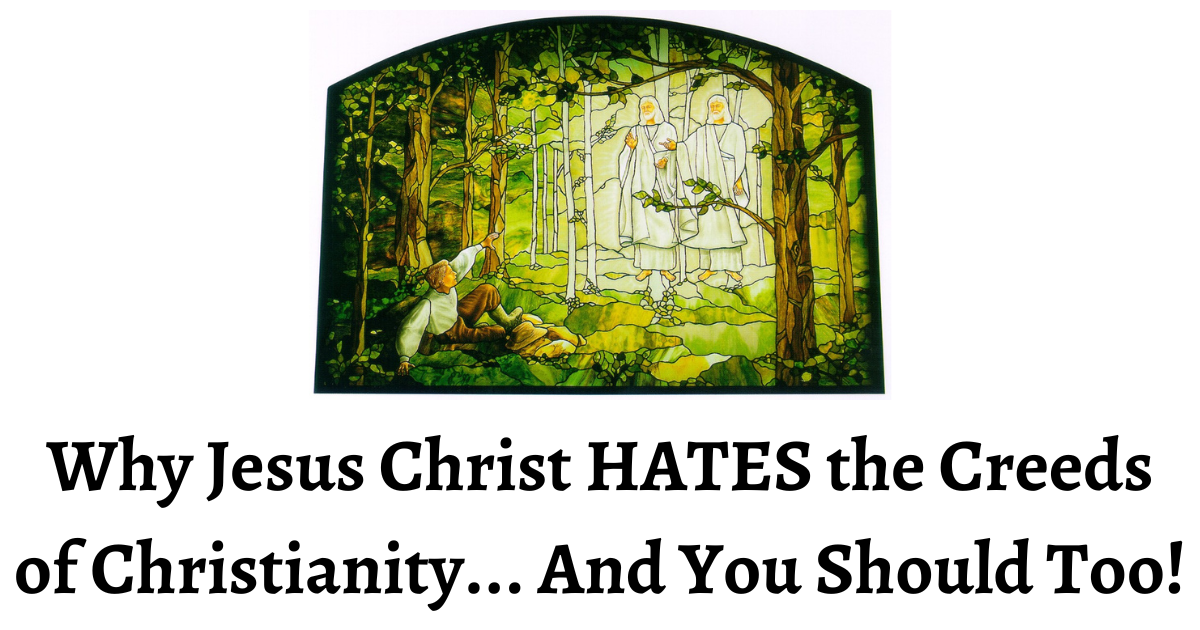
The Smith family moved to Palmyra in 1816. When they arrived, they worked hard on clearing their land of trees for lumber and so they could plant their crops. Joseph Smith Sr. did not clear the sugar bush on the west side of his property; the Smith family tapped these maple trees to collect the sap. The Smith Family instead of boiling the sap into syrup decided to turn it into sugar, something far more difficult but also more profitable. Of their endeavor, everyone was involved, and they succeed in producing more than 1,000 lbs of maple sugar annually. Because of their success in making maple sugar, the Smith family stayed in Palmyra. Because their land had maple trees, there was a grove that in the spring of 1820 a young Joseph was able to enter into and offer a kneeling prayer that was answered by the First Vision.
"Joseph Smith's First Vision"
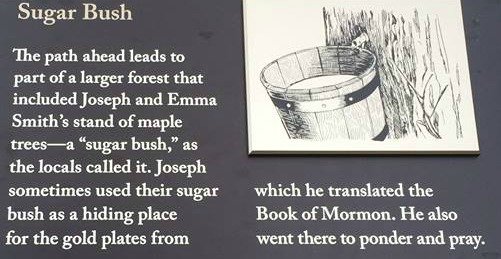
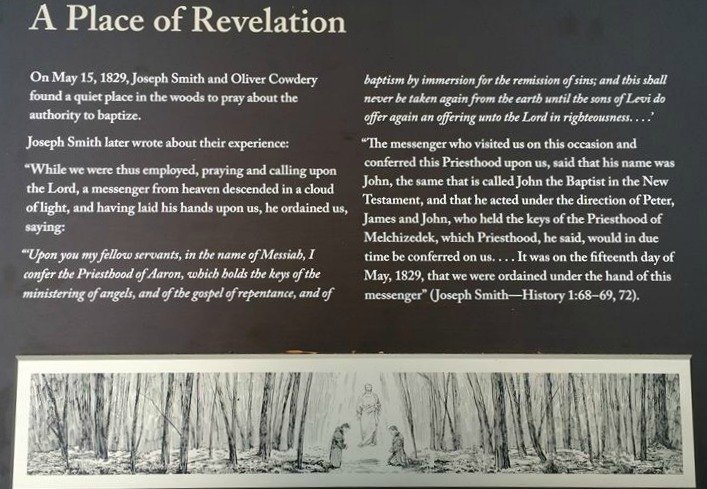
The Smith family tradition of maple tapping did not end in Palmyra. When Joseph Smith Jr. moved to Harmony Pennsylvania, Joseph located a nearby grove of maple trees. It was in this sugar bush that he often would retreat to pray. On May 15th, 1829 he and Oliver went to this sugar bush and knelt in prayer and John the Baptist appeared to them restoring the Priesthood. I learned this when I visited the Priesthood Restoration Site right after it was dedicated. I had always thought the Priesthood was restored on the banks of the river. While I was there, I saw a sign at the front of a path stating that this path led to Joseph's sugar bush. As I went down the path, I found a sign declaring the area for the Priesthood Restoration. Here are some pictures I took.


For me the restoration was kicked off by Martin Luther on 31 October 1517 when he posted his 95 theses and then proceeded to defend his views by standing up to the powerful catholic church. Both very brave men who stood up for proper change. Here is a quote from Martin Luther "All who call on God in true faith, earnestly from the heart, will certainly be heard, and will receive what they have asked and desired."
@Don Zimmerman, I agree this as well was a great help in inspiring & making waves to bring in the restoration ! A thought came to me as I read the quote is, this is true of all who call on God is heard & will receive what we ask for, if not immediately, it will. come,.On another thought that came, is I have learned how important it is to say, In the name of Christ,Thou Will Be done !!!! For Father knows best for us & times I prayed & got what I ask & it ws not good for me..
I'm note sure how accurate it is to ascribe the eruption of Mt. Tambora to a direct action on the part of God to move the Smith family. After all, the eruption caused untold suffering across the globe.
Having lived many years in France and learned the stories of Joan of Arc, I often wondered why God would have called her to save the kingdom. The English holdings in France were much larger than the kingdom's territory and the Dukes of Burgundy held more power than the king, so what was the big deal in saving the small centralized kingdom? After I joined the church and after watching BYU TVs marvelous production on Joan of Arc, I realized that without the kingdom of France there would have been no America and without America, of course, there could have been no restoration here. Joan of Arc was instrumental to the future restoration of the Gospel of Jesus Christ.
Also, there was Charles Martel (the Hammer) who kicked the Moors out of France in the 700's to preserve the region from the Muslim invading hordes, until at least now....
Thank you Don. Great comment!
There was a pamphlet when I was a missionary that I wish I still had. It had quotes from John Wesley - Martin Luther - Roger Williams - Thomas Jefferson and others. I can only remember pieces of it. "I have sought nothing beyond reforming the church. It does not appear that the extraordinary gifts of the Spirit... Can't remember but pieces but they were all men who could see the church / gospel had been corrupted.
I may have an extra one, what's your address.
Brad.
Just post it here in the comments or feel free to email it to me jeremy@mylifebygogogoff.com
If you would like the sources on the quotes here they are.
Thomas Jefferson was found in the book "the Real Thomas Jefferson" that I read growing up in homeschool. The source stated is "Letter of Thomas Jefferson to Jared Sparks, Nov. 4th 1820"
For the Roger Williams quotes here are the sources.
"There is no regularly constituted church of Christ on earth, nor any person qualified to administer any church ordinances; nor can there be until new apostles are sent by the Great Head of the Church for whose coming I am seeking." Picturesque America by William Cullen Bryant, p. 502, first published in 1872
“The apostasy… hath so far corrupted all, that there can be no recovery out of that apostasy until Christ shall send forth new apostles to plant churches anew.” (Underhill, Edward, “Struggles and Triumphs of Religious Liberty”, cited in William F. Anderson, “Apostasy or Succession, Which?”, pp. 238-39)
“We may conclude then that he left the church not because he had any doubts respecting the nature of baptism nor because he had been baptized by a layman but because he believed that no man is now authorized to administer the ordinances and that no true church can exist till the apostolic ministry shall be restored. With these views he could not conscientiously remain connected with any church nor regard his baptism as valid” Memoir of Roger Williams, the Founder of the State of Rhode-Island; James D. Knowles (Professor of Pastoral Duties in the Newton Theological Institution), Boston, Lincoln, Edmands and Co., 1834, p. 173 as read from Google Books on 2012/03/10
I don't think God caused a volcano to erupt, killing 500,000 people just to push the Smith's to move to Palmyra. Vermont was already a difficult place to live before the year without a summer.
No one can really know if it was God or just nature, but there have been ensign articles about how Joseph Smith Sr always stayed near family in Vermont, but this event caused him to leave the state.
https://www.lds.org/ensign/2015/06/the-path-to-palmyra?lang=eng
You are providing a great service - I just discovered you! Enjoyed your "article on "Three Things You Did Not Know About the Restoration"
Great article with deep spiritual meaning for all. Thank you for your efforts on this. I didn't know about the maple trees. Very interesting.
Just discovered this. So glad I did. Very touching article with important information about how God spent centuries, inspiring men and women to tasks that would eventually lead to the important restoration of the gospel! thank you for this.
Nice Read
I "cut and pasted" your article, "Three Things You Did not Know about the Restoration", crediting you as the author for a non-member I'm trying to interest in the Book of Mormon.
It won't let me complete the save due to file permissions.
Would you possibly grant me those permissions so I can continue gathering the articles for my friend? BTW I've enjoyed all your pieces.
Thank you for allowing this,
Paula Powell
I emailed you a copy.
Roger Williams was obviously ready for True Christianity to be restored.
Had he not been born two centuries too early, I can easily picture him together with Joseph and Hyrum Smith building up Zion.
So very interesting, I'm so grateful for learning new things.
You need to check your date of the Smiths’ move to New York. 1816 was the “year without a summer” not the year they moved. They moved in 1818 or 1819.
"In 1816, after facing repeated crop failures, Joseph Smith Sr. moved his family from Norwich, Vermont, to Palmyra, New York, hoping to find a more prosperous situation."
https://www.churchofjesuschrist.org/study/manual/teachings-joseph-smith/the-life-and-ministry-of-joseph-smith?lang=eng
I think around 1979, (or 1989 or a few years way back) the Ensign printed over a period of a few months, "How the Bible Came to be." It details those martyrs who help the Bible be translated from Hebrew to German and English. Early on the Catholic church had 70 monks translate the Bible from Hebrew to Greek for a missionary effort. The encyclopedias mention The Reverend John Rogers as being one of these martyred in 1555. He was a Vickor for The Church of England so as a "man of the cloth," he was allowed to marry. He was burned at the stake and left a widow and 11 children.
While the maple trees and tthe real reason for the move was he volcano look like great resons for moving to Palmyra, I feel certain that the location of thnumber one in the Lord's e plates was the number one priority for the Lord. They had to be translated by the prophet which would have been difficult from 300 mi away.
Thank you for the information about Roger Williams. He is my 9th great grandfather, and I did know some things about him, but your article has added a great deal to my knowledge of him, things of which I had no idea.
On a side note, another 9th great grandfather was Thomas Angell, who came from England with Williams as an indentured servant, and went with him to Rhode Island. Today, two major streets in Providence, Rhode Island are Williams Street and Angell Street.
Again, thank you for the information.