
My Bishop Changed One Tiny Thing And It Totally Changed Sacrament Meeting.
My Bishop Changed One Tiny Thing And It Totally Changed Sacrament Meeting.
Sacrament meeting should be a place people receive revelation in the Church. But, often our Sacrament meetings are lackluster and people are leaving without revelation. One of the main reasons for this, I believe, is how we approach talks in church. See, we have amazing role models in the conference talks by general authorities. But rather than following the model set by their talks, we actually assignment people to talk based off the text of the conference talk.
The problem is that conference talks are best reviewed in lesson format that enables discussion, not in talk format that causes it to be rote. One of the most frustrating things is when you are assigned to talk on a talk. The last time that happened I was asked to review Elder Holland's most recent conference address. I felt woefully inadequate to expound upon his sermon. What could I add to his words? I am sure that I am not the only one to feel this way.
Personal Conversion Stories.
When my homeward got a new Bishop he decided to do things differently. He understood that conference talks are like the Lord's Prayer, they lay out a pattern; but they are not to be rotely repeated. So he made one tiny little change and decided to ask members of the ward to give talks, not talks based on talks, but real talks. He would ask them to share their conversion stories to the gospel principles, or their conversion story in general. (This is how the Apostles and Prophets deliver talks; they teach true doctrines through personal stories, expounding scriptures, and mixing in quotes from church leaders.) He saved reviewing conference talks for the classroom.
Suddenly Sacrament meeting was revived. Members were more willing to give talks. In one case, the Bishop asked a less active sister who had not come to church in over a decade to come to church, but not just come, but to give a talk (share her conversion story). And she agreed! She shared the story about the missionaries tracting into her family in the Navajo Nation. She talked about how they taught her the gospel and how she shared it with her sisters, and how they all got baptized. My dad said it was one of the most powerful talks he had ever heard. See, my Bishop stumbled upon a truth. Many members are not experts in conference talks. And they don't need to be. What they are experts in is their conversion story. And many members are willing to share their own conversion stories.
This does not mean you can only have talks about joining the church. Everyone must be converted to each of the gospel doctrines. Imagine a sacrament meeting where the Bishop asks the members, "can you share your conversion to the principle of Tithing? Share the quotes, scriptures, and stories that led you to a testimony of tithing." Do you think that would be more powerful and effective than if the Bishop asked them to give a talk based on someone else's conversion and testimony? aka the talks of the Apostles and Prophet.
Testimonies vs Talks vs Lessons.
Because we are robbing them of the ability to actually give a real talk and share their conversion story during a normal sacrament meeting, on fast Sunday members stand up and give talks and stories rather than testimonies of Christ. This past fast Sunday I heard many amazing talks, but only a few testimonies. Here is a simple example of the difference.
Testimony: A personal witness of Jesus Christ and any other gospel principles.
Testimonies should be short, sweet, and to the point. (1-5 minutes). You are not called to give a sermon or a travel-log, but to testify of Christ. The Prophets have given guidance on what types of testimonies are appropriate to share in church, here is some more info on that: Three types of testimonies we have been told to avoid.
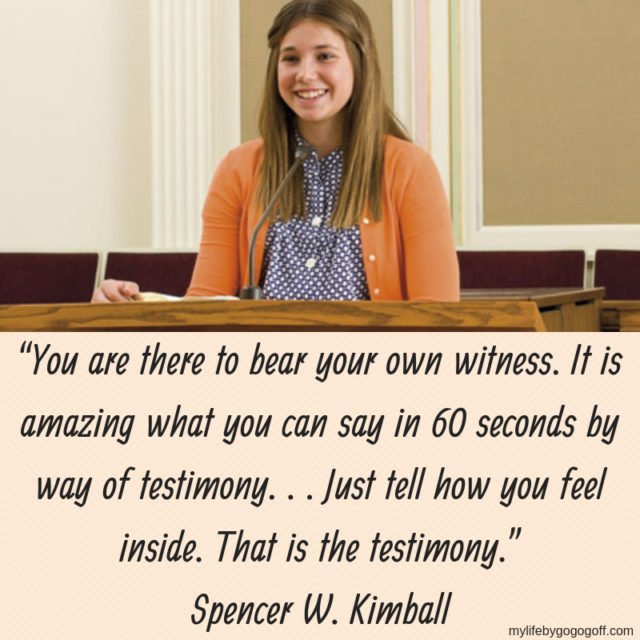
“You are there to bear your own witness. It is amazing what you can say in 60 seconds by way of testimony. . . Just tell how you feel inside. That is the testimony.”
Spencer W. Kimball (Teachings of the Prophets Spencer W. Kimball Chapter 7)
Talk: A short sermon on an assigned gospel principle.
A talk is a short (5-20 minute) sermon. It should come from the heart, it should contain personal stories and experiences. It can and should also contain quotes of either church leaders or the scriptures. A talk should always end with a testimony of Christ and the principle.
“One reason why personal experiences are so effective is that they have touched our hearts—and when we speak of things that we feel deeply, it is more likely that we’ll be able to touch the hearts of others. If you read a lesson and tell a story in someone else’s words, it won’t have the same impact. … It is easier for us to apply a truth if we can see it in action in someone else’s life. And it is easier to commit to live a truth if we can feel the Spirit through those experiences of other people.”
Elder Gene R. Cook
For tips for giving talks in church. https://www.lds.org/study/new-era/2018/07/7-tips-for-giving-a-talk-in-sacrament-meeting.html?lang=eng
For tips for sharing personal stories powerfully https://www.lds.org/ensign/2002/09/telling-personal-stories?lang=eng
Lesson: An interactive discussion about conference talks, or lessons from manual.
Lessons are the prime location to review conference talks. And to learn the gospel. Whereas a lesson can be as short as 10-15 minutes they can also be as long as an hour. A lesson without participation is a lecture. But when there is a group discussion, then we can all share our personal insights on what we learned, and no one will need to talk the whole time and lecture. Ask questions, give assignments, and ask others to share their personal stories and testimonies on topics.
“Involve as many people as possible during the instruction period by inviting them to read aloud, answer questions, or share experiences”
(Teachings of Presidents of the Church: Brigham Young [1997], vi).
A Time And Place For All Things.
Once you learn there is a time and place for all things, then we can focus on making sure we share the gospel appropriately. Testimony meeting will be full of testimonies, in sacrament meeting people will be given the chance to give real talks, and in our classes, and at home, we are using the proper format of lessons. When we do this we will realize there is power in teaching and learning the gospel in a variety of ways.


This is a tough one. We lived in a stake that was pretty 'Orthodox' when it came to talks for Sacrament - and that they needed to come from the most recent General Conference.
Then we've lived in a couple of stakes where this wasn't observed.
Here is what I saw....
In the wards where Conference talks were NOT assigned, there tended to be a good deal of 'iffy' doctrine shared, a lot of 'guessing' as to what certain doctrine might be, even false doctrine taught from the pulpit. And while personal experiences can be great teaching tools, more often than not, people would go off on tangents when they didn't have an outline of doctrine to follow. When a random subject was assigned, rarely were Prophetic quotes or even scriptures used. Sometimes it was even difficult to decipher what the topic was supposed to be.
Conversely when a recent Conference talk WAS assigned, this is what I noticed:
Usually the Bishopric, through the Spirit, chose talks with subjects that they felt their congregation particularly needed -after all, the First Presidency, Apostles and Conference speakers had just done the same thing - through prayer and the Spirit they had chosen subjects that we need to focus on NOW.
I find that when I listen to a talk where others share insight they received from a Conference talk, including their own personal experiences that add testimony to the words of the Apostles, that I gain new understandings and see things I had missed in the talk.
A good speaker knows how to use these talks as an OUTLINE, and going by the Spirit, will know how and what to add to the talk like scriptures, personal experiences and even portions of past Conference talks to relate the talk to themselves and those in the Congregation.
The past two conferences have been absolutely mind-blowing amazing. For those who have ears to hear, there has been a huge shift and change in what Church Leaders are telling us as well as what they are trying to prepare us for.
In my humble opinion, the ONLY thing that should be used for Sacrament meeting talks (with the rare exception), ARE the Conference Talks. Who knows better what we need than the Prophets and Apostles - especially in these winding up scenes.
I'd rather hear my neighbor's ah ha moment when they read the BoM for the first time then some 20 year old regurgitate somebody else's talk any day. Isaiah criticized the Ephraimites in his day. Said their tables were filled with vomit. Vomit may be a bit crude but if you take their message and have someone else regurgitate it for your congregation that regurgitated portion its not going to taste the same. It may taste good if that is all you know.
People find God in many ways and their stories are worth more to me than a stack of general conference talks. Having served for years in a Bishopric I can promise you that the Spirit isn't even remotely involved when it comes to assigning conference talks to be the topics in sacrament meeting. It's a copout, it take very little effort to do and mostly involves going down a spread sheet looking for people who haven't spoken and just copying and pasting them into open slots with little regard. Theming and coming up with your own topics and going down the list of members that could deliver effectively, that takes time, pondering, focused thought and a bit more effort. Having convinced my own Bishop to do what this article implied years ago made sacrament meeting palatable again. We got ah-ha moments, heard of conversion stories, saw members in a completely new light, it brought us closer as a ward. You can't get that by piecing together quotes and deferring spirituality to only those with faces in the Ensign center fold.
If my Stake were like Jodi just described, I would probably have a chat with the Stake President. If that did not work, I'd probably try to take it up higher, to Church headquarters if necessary. I've lived in a Ward where all the talks were talks about General Conference talks. This is the best way to ruin the Church and drive members away. I agree wholeheartedly with this article. There is no direction from the Church that talks should be based on General Conference talks. The direction is that Elder's Quorum lessons are to be based on talks from the most recent General Conference. I agree with this approach. If members don't know how to give talks or present "iffy" or false doctrine, there are other ways to deal with that besides boring the congregation every week with "book-report" talks. I can read the conference report myself and enjoy discussing conference talks in a classroom setting.
Excellent!
@Jodi Stoddard, I'm always wondering why the Conference talks seemingly must be used at all. It wasn't that way during most of my life. Is it more powerful to use content from a talk or content from in depth scripture, studied and quoted-also from Apostle's books? I remember the day when we all had studying to do to be a teacher on a subject under the power of the Holy Ghost. Is it wrong to give a "conference" talk of our own by the Power of the Spirit?
@Erik Hansen, and using scripture like the Book of Mormon isn’t? The decades of General Conference addresses is our modern day compendium of heaven-sent scripture. We should treasure it just as we treasure the Lord’s words in ancient scripture. I feel like this article is just an edgy take by authorities in general who don’t like being assigned a talk. Yes, we can be assigned a talk but it does not have to be the only point of reference of inspired material in making our sacrament meeting message because if we have been applying the message as we should, it should be easy to talk on it. I have seen people flourish spiritually in approaching sacrament meeting talks either with assigned talks or assigned topics. What makes the message is the Christ-centered focus in the message bringer. You aren’t adding to or detracting from general authority’s modern message when you expound on their words any more than when you do the same with words of scripture from anciently. I think ancient prophets would be delighted to see us expounding on our general authorities’ words just as they would be delighted in expounding on their prophets’s words like Isaiah and Jeremiah.
This was so helpful. Thank you!
I disagree with this approach. Conversion stories are personal and often include a lot of things that are just for an individual. We are counseled not to share miraculous accounts. Also, as one shares their conversion story over and over it becomes less sacred to them. Then you have a congregation that is coming to listen to someone else's conversion rather than being taught doctrine and principles that allow them to get their own. Not only does it diminish the initial experience for the person sharing it, but the congregation is borrowing light and that doesn't sustain. What your bishop is doing, though it may make sacrament meeting feel more exciting, is contrary to what we are taught by our leaders. Reviewing talks and scripture may seem dull but the point is to stick to doctrine without adding or taking away so that we can simply invite the spirit to teach us individually as we are reminded of gospel principles. It's up to you what you take away from a talk by how much preparation you have given. This is very very wrong of your Bishop. We are not there to further expound on a talk we are to teach plain and simple truths and bear testimony.
@SB, from my experience there has never been a time where the Saints needed to study and teach on a subject more than now. Bearing a testimony is important. In a talk we might need to be teaching based on scripture, the words of many apostles -from their books- and scholars, not just the ones from a talk we've just heard. In my lifetime I've never seen more laziness from the Saints to be quite honest.
In my last ward the instructions for sacrament meeting talks specifically said do NOT share personal stories.
That's interesting, we are told to share personal examples of our experiences relating to the principle we are talking about.
Same here I believe if bishopric ask someone to give a talk it’s my decision to choose the topic and the spirit will guide you,conference talk also discuss in class..but if we told by our living prophet to do so,then I will follow
I have never heard of assigning conference talks for sacrament meeting talks. We are usually assigned topics around here. Recently my husband and I were asked to speak, but not given any assignment. A few weeks prior, while not being able to sleep, I thought about one of my son's football games and how a specific incident related to the gospel. So many thoughts came and I felt the Spirit so, so strongly. Before finally drifting off to sleep I thought how this would make a good talk, but kinda chuckled to myself because I never get asked to speak. Well, I did use thoughts. Interestingly, I shared some of it with my husband before hand, but then added something at the end. It was a perfect lead into his talk (I had no idea - he didn't share with me).
I am not a good speaker - I would never be able to do justice to a talk by any General Authority. In fact, it would probably kick my anxiety into high gear. But with this talk, I knew that it was what I was supposed to talk about. I felt good during the preparation, peaceful as I got up to speak and had the distinct feeling that Heavenly Father was pleased with the outcome.
Great !!!!!!!
I very much enjoyed the Christmas Sacrament meeting I attended in which the choir sang selections from Handel's "Messiah" interspersed with five-minute relations by different about the birth of Christ *in their lives*.
A great way to prepare for a talk or lesson on a conference talk is in the "Teaching in the Saviors Way" booklet, part 2, Make a plan. There is a sample teaching (talk) plan on page 19 that helps teachers and speakers prepare with thoughts, questions to ask and encourages using supporting scriptures. Church resources are there for almost any lesson, talk, family home evening or gospel council/discussion.
The saddest thing I've ever read: "We are counseled not to share miraculous accounts." And done in the passive voice so there's no questioning the source. Sigh. When this is widely believed, the Church is dead.
I don't remember many Sacrament talks but the ones I do remember are personal experiences. I love to hear how the Lord works in the lives of others. I love to hear how prayers are answered. It builds my faith. Yet after giving a talk on how the Lord blessed me and my family by giving a generous cast offering, my Sunday School teacher approached me and advised me that personal experiences were inappropriate. "What if there are those who are struggling with fast offering?" I asked. I was told that they need to consult the scriptures and not the ward members. Yet it was a testimony of fast offering that motivated me to try it and I was blessed for doing it. I'm sure a lot of calls under a matter of opinion.
If anyone is wondering what a sacrament meeting talk should or should not consist of, look no further than the Church Handbook of Instructions: Book 2, 18.2.2
"Orienting Participants. Members of the bishopric orient sacrament meeting participants. They review the purposes of sacrament meeting and explain that all talks and music should be in harmony with the sacred nature of the sacrament.
When inviting members to speak, a member of the bishopric clearly explains the subject and the length of time the person should speak. He counsels speakers to teach the doctrines of the gospel, relate faith-promoting experiences, bear witness of divinely revealed truths, and use the scriptures (see D&C 42:12; 52:9). Speakers should teach in a spirit of love after prayerful preparation. They should not speak on subjects that are speculative, controversial, or out of harmony with Church doctrine."
President Nelson taught in the first World Wide training that sacrament meetings should be focused on Jesus Christ and his doctrine. The problem with how talks are assigned for sacrament meeting is that assigned topics are often more instructional rather than worshipful. When we focus on personal testomony and teachings of the Savior the Spirit is more present, because pure truth is being shared. Doctrine and Covenants section 50.
Such a delicate balance. On one hand, I frankly have zero interest and zero need to have a speaker in church essentially re-read me a talk that I listened to during conference and then read myself either on-line or in print in the ensign. And sadly that is pretty much what every "conference talk" sacrament talk that I've heard turns out to be. It feels like a complete waste of time. On the other hand, I have heard many many MANY faith promoting rumors and "personal experiences/opinions" passed off as "gospel" "doctrine" or "commandment" over the pulpit (or even more frequently, in relief society). Which can be dangerous, especially to new converts or investigators who think that speakers "speak for the church" and know what they are talking about. And who hasn't had the experience of Brother or Sister Nutso getting up and letting fly with all kinds of crazy? With a lay ministry and a participatory teaching style that we have, it's inevitable. In general I'd prefer and probably get more out of hearing people's personal experiences. I can and do read the scriptures and study on my own. I think we just need to be careful to be crystal clear that what we are speaking about is our own experience and not the official policy or position of the church and not necessarily correct doctrine.
Two things.1) Some of those in our ward give talks in testimony meeting. Others go on and on listing for what they are for. l have always called it a thankfulmony. 2) Our bishopric assign a topic for the whole month. by the end of the month the talks start sounding the same.
Regardless of topic or assignment, the most important thing we can do for the members of the ward is to make it possible for the Holy Spirit to bear testimony. We need to be aware that every member of the church has issues, and may be engaging in a mighty struggle. They all need a witness of the Spirit in church, as they may not receive it any other way.
That's the same prescription for people who are not church members who may visit our ward.
This meeting may be the only link between a struggling/inquisitive soul and God.
Like Anne, I had never heard of assigning conference talks to members as topics for Sacrament Meeting talks as something commonly done. I know that this is how high counselors in my stake are assigned topics, but that is not what is one on the other Sundays.
I am in the bishopric in my ward and each Sacrament Meeting has a theme and then the bishop usually writes about a half dozen questions on the topics, similar to the Come Follow Me youth curriculum. He might suggest a scripture block or a conference talk as a reference or starting point, but the topic is a question to answer. Then when inviting the member to speak, we talk with them about the topic and select one or two of the questions for them to answer in their talk. Personal conversion stories and testimonies are highly encouraged. I don't know if this is the best way to assign talks, but this is what we do in my ward and it seems to be working.
I agree. Usually the prophet states that most conference talk subjects are not assigned. Meaning that God our Heavenly Father will give us revelation as to what is needed and what to say. Some guidance as to suggested topics or talks to review in preparation for a talk should be helpful. I honestly believe that the Lord trusts us. I believe that he also will inspire us to do and say the right things.
Nice one. However, it still depends to the bishopric because the bishopric receives revelation what is best for their sacrament meetings. We don't have the same wards or branches and we have different situations.
Wow that's fantastic! I'm really touched by these and it reminds me of a talk i gave and afterwards someone came up to touch my shoulder "you've helped me:
One of the most memorable talks I ever heard was from my youth. A boy was assigned a talk on tithing. He got up and said, it you would pay oyur tithing, I would't have to give this talk. He then said Amen and sat down. I have never forgotten that talk and I have never forgotten to pay my tithing.
Two talks I remember from General Conference -- given thirty years ago:
Elder Hartman Rector Jr. "Be Nice" -- He elaborated a bit, but mainly he said - "Can you imagine anyone getting to the celestial kingdom who isn't nice?"
Elder Jakob deJager "Don't do dumb things."
I appreciate this clarification! Thank you!
I liked this approach a lot. I do understand that it requires instructioin by priesthood leaders on how to present a talk and what should and should not be included in it;
I also understand the usefulness of presenting thoughts and ideas from General Conference. I would personally prefer an assignment that said, give a talk for 15-20 minutes on "x" topic. Please use as your initial resource material the talk by "Y" member of the First Presidency or Quorum of the Twelve in the latest (or an earlier) General Conference.
I would use that material to get some ideas on what kind of things I feel are useful in the ward in which I was speaking. I would also refer to earlier General Conference talks as well as the topical guide from the scriptures to research the material. While preparing I like to keep a notepad by the bed. I sometimes would wake up in the middle of the night and write down ideas that had come to me which were specific to the talk I am working on.
I remember back in the day when we used to have "Prayer Meeting" for those who were going to speak in Church that day -- it lasted maybe ten minutes at the very most, but a prayer was said asking for the spirit to guide and attend our remarks, reminders given on not going over time,
Of course we don't do that anymore, or not that I am aware of.
I like your ideas a great deal!
I have gained a great deal from this article and from the responses that have further added thoughts and ideas.
I'm not in a bishopric or any leadership role for that matter and so, I have little or no influence on how Sacrament Meetings should proceed.
I do feel, however, that there needs to be some structure and guidelines for each talk given - as well as a time limit.
The last time I was asked to speak, the speaker before me used up about 45 minutes of the meeting. Including opening hymn, passing of the sacrament, etc., I had exactly 5 minutes to share my remarks. Ten minutes seems sufficient for most General Conference talks.
I too become weary of talks that spend a considerable amount of time talking about how much they hate giving talks and shouldn't have answered the phone. And then just reading a talk out of the Ensign. I learn so much more when a General Conference talk is assigned by way of topic / outline - structure / and principals.
For example: Elder Holland's "Broken Vessels" talk. We can share how someone reached out to us, or how we came closer to Christ by reaching out to someone otherwise misunderstood, etc.
Having spent a number of years as a High Council member and being assigned to speak in wards across my stake, I learned very quickly that an assigned General Conference talk gave me an opportunity to liken the principles and doctrine taught in conference to my own life experience and testimony. I did sit through a number of 60% quoted HC talks from other members of the stake, and those reinforced my commitment to do as Nephi instructs that we liken the message to ourselves. Now, as a bishop, I have will on occasion assign a conference talk "theme" to someone, but share with him the importance of delivering the doctrine and their personal experience with it. It does lead to more focused messages and doctrinally sounds teaching, while allowing them more liberty to take the stories and conclusions their own way. I think it can be a very good way to encourage timely teaching in our congregations, coupled with talks that take a verse of scripture as a theme as well. A little forethought and conversation when making an assignment goes a long way.
Each ward has different needs and bishops approach each need according to the promptings of the spirit. We should not question if our bishop is doing some things differently from the other bishops. The church is led by revelation, and each leader is entitled to a revelation based on the needs of his members. The 2021 Come Follow Me curriculum year clearly teaches that principle. Brigham Young also said that we cannot be saved without personal revelation. If leaders are prone to directing members instead of guiding them in their responsibilities, they are taking away their privilege for personal revelation, and that is contrary to the basic principles and doctrines of the Church. Thanks to this bishop who understands the role of personal revelation in the establishment of the Lord's kingdom and for allowing the members of his ward to apply the same principle in their carrying out the Church assignments. Great article!
For me the answer is let the Spirit talk what ever it is,just be an instrument!
The Spirit is the teacher , not the speaker!
I wonder if there has been any instructions to talk givers about showing the power of Christ in personal stories, and not how they themselves have blessed other lives. We have many in the ward that talk about the good things they have done and never correlate it back to Christ. This makes me feel uncomfortable.
Interesting article. Sacrament meeting is such an important meeting where people come, sometimes at great sacrifice, to partake of the sacrament and to be instructed and comforted by the Spirit. The general handbook says this about assigning speakers: 29.2.1.4 …The bishopric extends invitations to speak well in advance of the meeting. Speakers bear testimony of Jesus Christ and teach His gospel using the scriptures (see Doctrine and Covenants 42:12; 52:9). Messages should build faith and be consistent with the sacred nature of the sacrament.
D&C 42:12 12 And again, the elders, priests and teachers of this church shall teach the principles of my gospel, which are in the Bible and the Book of Mormon, in the which is the fulness of the gospel.
D&C 52: 9 And let them journey from thence preaching the word by the way, saying none other things than that which the prophets and apostles have written, and that which is taught them by the Comforter through the prayer of faith.
When someone is assigned a gospel principle to speak on and they put in the effort to study the scriptures and teachings of the prophets on the subject and pray for guidance from the Spirit the Lord will help them write their talk. It is the Lord’s church and he knows what the individuals in that ward need. This process of study and revelation is a great blessing for the speaker and the congregation. Notice how the Lord does not tell us through the prophets to base our talk on one particular conference talk? Certainly presiding authorities can use conference talks as a guide for subjects or gospel principles to be included in talks. In a ward the bishopric can pray and receive revelation on what should be spoken about and who should be asked to speak. Giving the speaker instructions on the subject, what is appropriate and not appropriate, and the sources they should look to as they study the subject and prepare their talk is the duty of the bishopric. A sheet explaining how to give a talk and guidelines on how to prepare and speak is very helpful in my opinion.
The handbook also says this:
“Occasionally something happens during a meeting that the presiding officer feels a need to clarify. For example, someone might teach incorrect doctrine. If that happens, the presiding officer should make a clarification without embarrassing anyone.”
I pray that we can improve our sacrament meetings and create an environment where the Holy Ghost can be present and teach and strengthen each of us in our testimonies of Jesus Christ and his restored gospel.
I am a member of the church since 30 years and cannot remember one talk in the sacrament meeting about a talk of an apostle. In our little ward in germany ist was like you describe all the years.
I can see, how thankful we can be.
Be thankful your ward does not do this. It is very prevalent in the USA.
We do not “give talks” in Sacrament meetings we SHARE MESSAGES that teach and expound on the principles and teachings of Jesus Christ—refer to Elder Bednar’s instructions. Also, while conversion stories might be interesting they are stories sprinkled with scripture (sometimes) with very little to no reference to the Savior and His Atonement. If and when Church leaders and members learn this simple change, then Sacrament meetings truly become a learning and personal revelatory experience
I'm always wondering why the Conference talks must be used at all. It wasn't that way during most of my life. Is it more powerful to use content from a talk or content from in depth scripture, studied and quoted-also from Apostle's books? I remember the day when we all had studying to do to be a teacher on a subject under the power of the Holy Ghost. Is it wrong to give a "conference" talk of our own by the Power of the Spirit?
There are goods and bads both ways. It comes down to people seeking to teach by the Spirit whether they're using the conference talks as resources or given another topic. It's also up to the hearer to seek to be taught by the Spirit. I've been taught by the Spirit during talks that weren't put together well, and I've also been lax enough to not feel the Spirit during amazingly choreographed masterpieces of talks. It just comes down to the Spirit testifying of truth spoken and the hearer being prepared to listen to the Spirit.
I am a member living in Germany. Never ever have I or anybody else in my ward been asked to give a talk about a talk. So maybe this is more of a cultural phenomenon in the U.S. or limited to some wards.
I love conference. I got up at 2am to listen live and then again at 6am to listen live. The singing of the youth was wonderful. I am impressed how the youth and children are getting this great experience. They will never forget how they felt. And I would not forget how I felt watching live and seeing the children sing, an experience they will never forget. I have been to America 4 times and to a few states.