
Black Jesus? Greek Jesus? White Jesus? A Latter-day Saint Perspective
Growing up in Utah I never thought about race. My friends included Tongans, Samoans, Caucasians, Hispanics, Asians, and African Americans. But never once did I think anything about the fact that my friends looked different than me. That all changed when I moved to Memphis, Tennessee. I was thrust into a different culture; suddenly race became the most important thing about everyone. It did not matter who you were, or what you did, the first thing that mattered was the color of your skin. I got pulled over by the cops for being in a "black neighborhood." and I was warned by African Americans "Make sure you get out of this neighborhood before nightfall, or they will shoot you for being white."
It was a culture shock. But it was within this context that for the first time in my life I saw a painting of the Last Supper where Jesus was black. I was genuinely shocked. Thinking that this was an attempt to paint Jesus as something He was not, I talked with my Auntie about it. She was married to a Samoan and was not shocked at all. She informed me most Samoan artwork depicted Jesus as Soamoan. A little while later I was in the home of a Greek Family, and I saw their painting of the Last Supper and it depicted Jesus as being Greek.
Jesus in our image.
Satan wants us to feel like God is some distant and foreign ruler, removed from us as much as possible. Yet the Bible is clear, we are children of God (Romans 8:16–17). We were created in the image of God, (Genesis 1:26-27). So it is only logical that in our religious art, we depict God as looking like us. If we are black, He will be too. If we are white, He will be too. We are going to see Him in our image, after all, we are in His image.
It is important to understand the meaning of religious art is not to render a historical depiction of Christ. But rather to render an intimate depiction of Christ. A Christ that we can connect to, and feel understands us. Within this context of art connecting us to Christ, every Latter-day Saint should be not only tolerant and understanding of depictions of Black Jesus, but they should see the purpose of the depiction and rejoice that someone is coming closer to Christ.
The doctrine Satan fears.
Satan knows that we are all children of God. Not just that you are a child of God, but that I am one as well, as is everyone else. This doctrine is powerful. We are all brothers and sisters and the implications are enormous. C. S. Lewis put this doctrine in context when he said:
“It is a serious thing to live in a society of possible gods and goddesses, to remember that the dullest most uninteresting person you can talk to may one day be a creature which,if you saw it now, you would be strongly tempted to worship, or else a horror and a corruption such as you now meet, if at all, only in a nightmare. All day long we are, in some degree helping each other to one or the other of these destinations. It is in the light of these overwhelming possibilities, it is with the awe and the circumspection proper to them, that we should conduct all of our dealings with one another, all friendships, all loves, all play, all politics. There are no ordinary people. You have never talked to a mere mortal. Nations, cultures, arts, civilizations - these are mortal, and their life is to ours as the life of a gnat. But it is immortals whom we joke with, work with, marry, snub, and exploit - immortal horrors or everlasting splendors.”
― C.S. Lewis, The Weight of Glory
If we understood the Fatherhood of God and the Brotherhood of Man then Satan would immediately lose the vast majority of the ground he has won over the years. Therefore Satan has waged a propaganda war to divert us from this doctrine. His primary tool in this propaganda war is labels. Rather than us being children of God, made in His image. He encourages us to identify by "temporary or trivial" aspects of who we are. I am now my race, sexuality, or political orientation. Once we adopt worldly labels he can easily divide us and vilify the other labels. This is where the Hijacking of Black Jesus has come into play.
Black Jesus hijacked.
Race has been one of the most effective labels in Satan's war against God. The prejudice and hate purely based on someone's skin color has been easy to stoke, and hard to stifle. Within the Church, some have fallen for his propaganda and seek out ways to be offended on behalf of others due to real or perceived racial issues. One of the issues they see is the lack of Black Jesus depictions in the Church as a sign of white supremacy. They have fallen so hard for the propaganda of Satan, and they are so entrenched that they become crusaders not for Christ, but for race, even if it means becoming a crusader against Christ and His Church.
No longer is Black Jesus merely a way for people to find a connection with Christ, it has become a point of contention. Those on the left are angry at any white depiction, and those on the right view it as part of a culture war. And both sides end up focusing more on skin color than the Savior. Surely that is a win for Satan.
The Latter-day Saint Perspective
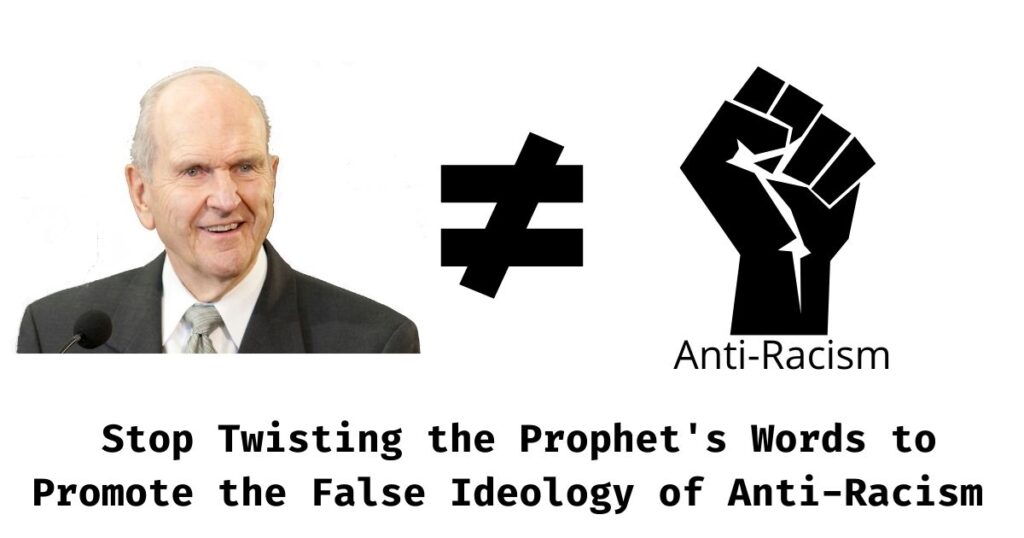
The Church teaches us that we are all brothers and sisters. That race should not play a role in our connection with Christ. Nor should it play a factor in our relationship with one another. President Oaks' referred to the label of race as "temporary or trivial in eternal terms" (See point 2 in his April 2019 talk "Where will this lead").
True Latter-day Saints focus on Christ, not his skin color. We realize that focusing on speculation regarding His race is a distraction from His mission. It does not matter what degree of melanin His pigment had. What matters is that He suffered and died for me and you. When we focus on "temporary or trivial" things we lose perspective on the Celestial things.
Therefore, it does not matter if Christ is black, white, brown, or any other color. It does not matter what degree of melanin our pigment will have in the resurrection. When we "Think Celestial" we will focus on what matters. And what matters is that Jesus is the Christ. What matters is that we are all children of God. That every single one of us has more in common than we have differences. We find joy in our unique backgrounds, perspectives, and cultures, but we will not focus on that. Instead, we will focus on the unity that comes in Christ and the doctrine that we are all Children of the same God, brothers and sisters.
If you liked this article, you might also enjoy these:





Thank you for putting race into perspective. I've always wondered about our Savior being depicted as white when He lived in the Middle East.
It doesn't matter. I feel at peace now realizing this, that we are all His children, and He doesn't care what color we are. Neither should we care what color He is! He's our Lord, Savior, and Brother.
And His children...we shouldn't worry about their colors, for they are our Brothers and Sisters!
How I love this attitude and feeling! How I wish all God's children could see and feel this way. Thank you again for your profound comments. They've made a difference to at least one person today.