
Addressing the Root Arguments of the Anti-Mormon Claims About Church Finances
Those attacking the Church often use half-truths or withhold context on true statements in an attempt to lead people to false conclusions. With Church finances, it is no different. I could attempt to rebut each claim they made, and I was planning on doing so, but instead, I want to address the conclusions they want you to reach.
Church Leaders Want People to Pay Tithing to Get Rich.
One of the most common conclusions regarding church finances Anti-Mormons want you to believe is that the Church leaders are doing this to get rich. Anti-Momrons point out the fact that the leadership of the Church gets paid a living stipend. They then imply that they are doing all these things to grow the wealth of the Church and then they imply that it will somehow financially benefit them.
The Truth: The full-time general authorities of the Church are asked to quit their full-time jobs and get a living stipend of roughly 120k. To put this in perspective, the BYU Football head coach makes more money every year than the entire Quorum of the Twelve Apostles AND the First Presidency combined. Also, this stipend is the same for the prophet as it is for the newest apostle. This stipend does not have bonuses if the Church takes in more tithing. There is no finical incentive to get people to pay tithing.
Furthermore, one could argue that there is no finical incentive to actually serve despite the stipend. President Nelson was a Cardiothoracic surgeon before he became an apostle. The average wage of a Cardiothoracic surgeon is 500k, and President Nelson was not average but rather a trailblazer. If it was about the money it was stupid to leave the medical field.
The Church is Nefarious and Only Cares About Increasing Tithing.
Another conclusion the Anti-Mormons want you to come to is that the Church is secretly nefarious and only cares about getting rich. This idea is laughable. If the Church really only cared about money then they would drop the Law of Chastity and the Word of Wisdom as requirements to go to the temple. If they were evil as the Anti-Mormons claim a move like that would add far more money to its coffers than investing money and having savings.
The Church Has No Legitimate Reason to Have Multiple Corporations.
The Anti-Mormons talk about the Church and all its corporations in an attempt to make you think it should only have a single corporation if any at all! This conclusion relies on the general population's ignorance of how corporations and subsidiaries work. Most people view corporations as purely an organization to get money. They see stories of politicians using multiple corporations to launder money and donations and overall the flavor it leaves in the general population's month is corporations = bad.
I work in finance. In the real world, when you want to do something, one of the first things that you do is create a corporation for the cause. There are many reasons to use corporations from limiting liability, and easier financial tracking, to tax advantages, and most importantly, for the Church, compartmentalization.
When the Church sees a need often a new subsidiary corporation is spun out to meet it, they are given a budget and a mission and then they are allowed to pursue their mission. But most importantly, they are able to pursue their mission as themself, not the Church. This matters because oftentimes the Church uses corporations that others don't realize are associated with the Church to help and serve people who would reject the help/message if the name associated with it was "The Church of Jesus Christ of Latter-day Saints."
For example, If you were a Pentecostal struggling with marital strife and saw an article on Facebook "10 tips to improve your marriage" shared by "Family Services of the Church of Jesus Christ of Latter-day Saints" you would NEVER click the article. Let alone read it, and gain the help. But if you saw it shared by a more friendly, general Christian title like, "I love my family" you are more likely to read it and get the help it offers.
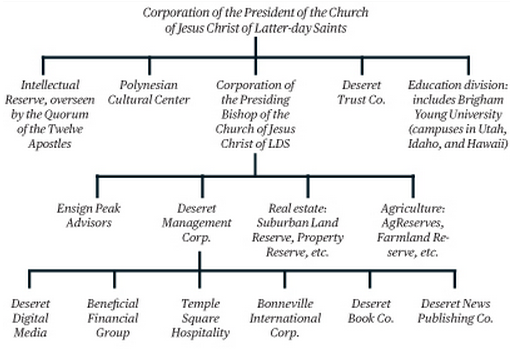
as outlined by Businessweek magazine in 2012.
The Church Having Savings is Immoral.
Another common Anti-Mormon attack is the very fact the Church has savings. They say things like "Jesus wouldn't have 100 billion saved up." Now, I have written in-depth about this topic see it here: We Should be Praising The Church for Having $100 Billion in Savings Not Criticizing It! But the root of the idea is that savings are bad. The problem is, that if the Church had no savings, they will attack the Church all the same saying "Look at how bad the church's financial position is! They don't even have savings!"
It is important to remember that the Church's alleged 100 Billion in savings is not 100 Billion dollars to only keep the lights on at the temple. Church funds are earmarked for a variety of uses, many we would expect like building new temples and subsidizing missionary costs to keep them reasonable to putting up #LIGHTtheWORLD billboards and ads on websites. But some costs we forget about, or never would think of, like the flowers at the visitor's centers, and the cost of the nearly 100,000 Church employees in their various corporations, with 50k in the CES alone!
But more than just paying the costs of the Church, the reality of the situation is that the Lord has repeatedly commanded the Saints to stay out of debt, save for a rainy day, and do what is needed to ensure His storehouse is full. It is important to understand that, unlike the US Government, which simply prints money for whatever it wants to do, the Church has to save it. The Church is also budgeting and saving funds far in advance to ensure that any project (temple, corporation, university, a new chapel, etc) is paid in full, and has budgeted to cover all operating expenses for YEARS. I was once told that the Church won't break ground for a temple unless it has budgeted construction costs as well as maintenance costs for 7 years.
We Should Not Pay Tithing, The Church Does Not Need It.
Really all these conclusions that Anti-Mormons push could be a variation of this one. They want you not to pay tithing because of _____. Fill in the blank, they will find a reason. Dislike BYU's current issues? Don't pay tithing. Struggling financially? The Church does not need your tithing to keep the lights on, so don't pay it! Can't go to the temple? Don't pay tithing.
But all these conclusions being pushed rely on an incorrect understanding of what tithing is. It is not a fee to enter the temple or to be a member. It is not us paying for the lights. Nor is it a donation to a charity that we have the right to know how they spend it. It is not a free-will offering based on our judgment. Tithing is fulfilling a debt we owe the Lord.
When we don't pay an honest tithe, the Lord clearly describes our actions as robbery. See Malachi 3:8-18. When the Saints are financially struggling if tithing was of man, the Church would suspend that law. ESPECIALLY in areas of the world where people live in abject poverty and paying tithing is a huge burden to them but the amount is almost negligible. Yet the Church teaches tithing still. The people who teach it don't get paid more money based on the tithing rates, in fact, all local leaders volunteer completely!
The reason the Church teaches us to pay tithing is simple; the Lord commanded us to do it. And has promised to open the windows of heaven if we do. That is why even in poor areas where tithing funds from an entire ward are not even a drop in the bucket to the Church, they still teach tithing. They know if you put the Lord first, He will bless and prosper you.
The Church is Avoiding Taxes
I love this attack by the Anti-Mormons. They point at the Church's financial strategies and say they are an attempt to avoid taxes. Yet the Anti-Mormons each year do all they can to lower their tax burden. None of them are saying, "Nah, I won't even take the standard deductions, I want to pay the full unmitigated rate." They avoid all taxes they legally can. Yet when the Church uses legal means to fulfill its mission they are upset that they are not paying more in taxes. It has nothing to do with taxes, even if the Church paid 50% in taxes, it would never be enough. Because the issue is the message the Church shares and the mission it is fulfilling. Saying they don't pay their fair share is simply an expression of anger at the message and mission.
The Church Could Do More.
Nothing burns a hole in someone's pocket faster than imagining how they would spend someone else's money. The final conclusion Anti-Mormons want you to reach is that the Church could and should do more with the money they have. The big problem, they think about people in need as the issue to fix. They see money as a solution. Yet if the welfare state of the US Government is any indication, even trillions won't "fix" poverty.
The Church views the problem completely differently, I've written extensively on this topic see (Reactions to The Church’s $100 Billion Savings Fund Shows That Many Saints Do NOT Understand D&C 104:16) To summarize, The Church views our selfish nature as the problem to be solved, not poverty. The Church teaches that the solution to our selfishness is serving those in need. I find this quote perfectly sums up this last point:
“The Lord doesn’t really need us to take care of the poor. He could take care of them without our help if it were his purpose to do so… It would be a simple thing for the Lord to reveal to President [Nelson] where the deposits of oil and precious ores are. We could then hire someone to dig them out and we could float in wealth—and we would float in wealth right down to Hades. No, the Lord doesn’t really need us to take care of the poor, but we need this experience; for it is only through our learning how to take care of each other that we develop within us the Christlike love and disposition necessary to qualify us to return to his presence.“
Marion G. Romney, Living Welfare Principles, Oct 1981
Conclusion:
I am not trying to say things are perfect, we know that the Church is administered by imperfect people. The fact that people make mistakes or do wrong things does not change the reality of the restoration or the truthfulness of the work. And regardless of how much money the Church does or does not have, the simple fact is the Lord has commanded us to pay tithing. That command is independent of how that money is used. As soon as the money leaves our account/hand it is no longer ours. The Church has no obligation to detail how it spends the Lord's money nor how much of it they have saved. We have no more right to ask about how 'our tithing money' is being used than we would have the right to go to the bank and ask them what they did with our mortgage payment.
I pay tithing because I have a testimony of the commandment. The Church could literally burn the money I send them, and I would still pay my tithing. Because my stewardship is over my actions, not others. I do not sit on the Council on the Disposition of the Tithes, and I am willing to bet you don't either. So let us focus on what we can and should do and not get distracted by those whose intent is anything but pure.


One of fundamental principles of the Law of Consecration and Stewardship is that *all* of the things that we are, or have, belong to God, and are a gift from Him (perhaps excluding only our will or moral agency, which was also a gift from God) – this is the first type of meaning, or sense of, the “pure love *of* Christ/God”: Love *from/by* God & Christ towards us, sometimes referred to as their “Grace”.
Thanks for your great article about tithing. My inactive adult son has lately been sending me articles and videos about how the Church "spends" tithing funds. I see through them for what they are, Anti-Mormon propaganda.
I'll be sending him this article to him and, hopefully, he can have a taste of our point of view.
I'm grateful the Church saves and invests the Lord's tithing. I'm grateful to be a full tithe payer, for I do see the windows of heaven open to me...not always financially, but spiritually, emotionally, and physically.
Truly, the Church sets an example for us to follow by their saving and investment. They also provide much needed service throughout the world with tithing funds, and we can also donate our own time when we can.
Again, thanks for sharing your insights and links to other documents...I'll be reading them as well.
The lawsuits that are out are not just dangerous to our church, either, but to all organized religion. I don´t think most Christians comprehend this. Maybe Catholics and Lutherans do, to some degree. If a group of dissatisfied members decides they want their money back and can somehow quantify and prove how much they donated, they can demand it back if they change their minds. These lawsuits could set a precedent that could bankrupt every church by means of class-action lawsuit by former members, and you know there would be shady lawyers lining up to find the clients.
For well over a century, the LDS Church and community have been a successful minority (In this case a religious minority) --building neighborhoods, cities and towns; farms and other agricultural entities, banks and financial institutions, colleges and universities, to name just a few examples.
These are the things that successful minorities do. Successful minorities do not play into other people's guilt trips or their agendas of victimhood. This is one big reason, I would suggest, why the LDS community does not get fawned over by the "politically correct" crowd.
Like you stated, I pay tithing because it is a commandment.
I understand full well that the First Presidency, the Twelve and the Presiding Bishopric line out the spending each year and I am fully confident that with these 18 servants of the Lord, all is well with the financial status of the church.
When I read in an article "Mormon Church has 100 Billion in Savings", my first thought was: "Awesome".
I know roughly how many temples are in the works, how many church buildings are built every year, and so on and so forth -- these are money consuming properties and not money making ones.
I trust the Lord, and that is it.