Melvin J. Ballard: Loving And Obeying the Prophets: The Key to Unity in Christ's Church - Oct. 1934
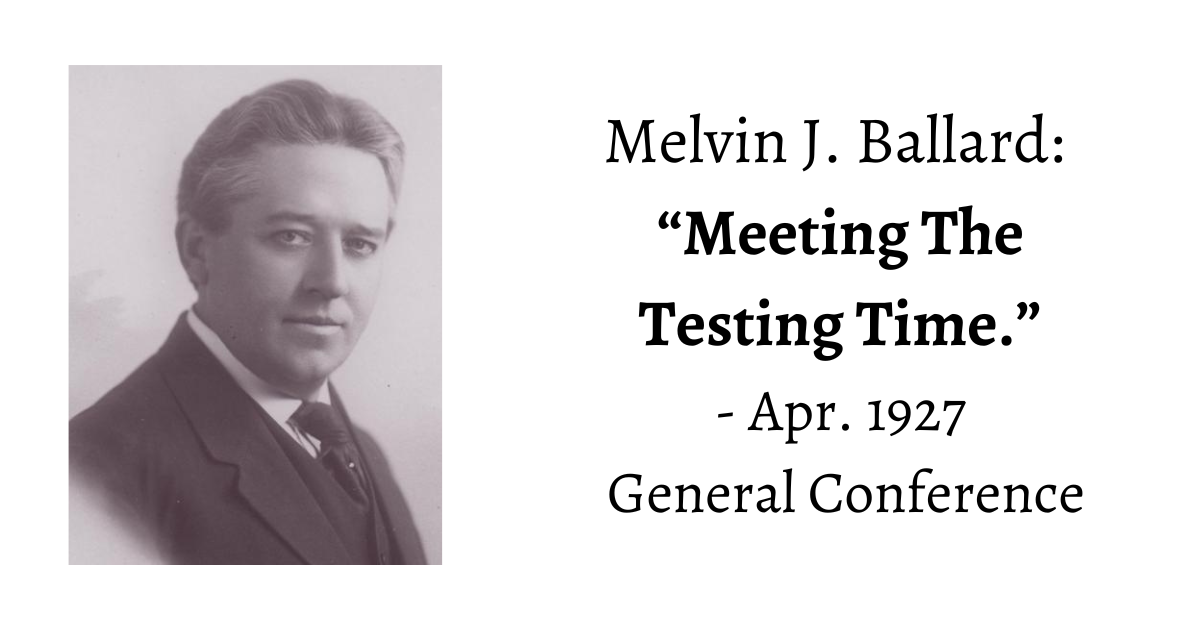
Before starting my study of the Conference Archives (The PDF Conference Reports pre-1971 that are not on the app/website), I had only heard the name Melvin J. Ballard a few times. Other than his "As an Oak Grows Slowly from an Acorn" prophesy about the Church Growth in South America, the main person quoting or talking about Melvin J. Ballard was his grandson President M. Russell Ballard. And yes, the M. stood for Melvin.
But once I started studying the older conference talks (1970-1940) I found far more references and quotations of the sermon and ministry of this amazing apostle of the Lord. I was excited when in my study backward through the conference archives finally reached 1939 and I started to read his actual sermons/talks at general conference. Their composition was, in my opinion, the perfect blend of personal stories and teaching pure doctrine that brought power and perspective! He immediately became one of my favorite apostles.
This morning, I read his Oct. 1934 talk and knew I needed to share it with you. This is one of the most important and powerful talks I've discovered in the last year of my study of the Conference Archives. Elder Ballard details how he learned lessons on on accepting callings, obeying the prophets, and loving our leaders from his gospel mentor President Anthony W. Ivins who had just passed away days before this talk was given. With no further intro, I give you Melvin J. Ballard's Oct. 1934 address!
Loving And Obeying the Prophets: The Key to Unity in Christ's Church by Melvin J. Ballard
Jesus said: "Verily, verily, I say unto you, he that receiveth whomsoever I send receiveth me; and he that receiveth me receiveth him that sent me." (John 13:20)
And again: "Verily, verily, I say unto you, he that believeth on me, the works that I do shall he do also; and greater works than these shall he do; because I go unto my Father... He that hath my commandments, and keepeth them, he it is that loveth me: and he that loveth me shall be loved of my Father, and I will love him and will manifest myself to him.
Judas saith unto him, not Iscariot, Lord, how is it that thou wilt manifest thyself unto us, and not unto the world? Jesus answered and said unto him, if a man love me he will keep my words; and my Father will love him, and we will come unto him, and make our abode with him." (John 14: 12,21-23)
A LESSON FROM A LIFE SERMON
I believe that the most powerful sermon any of us shall ever preach will be the sermon of our lives. I should like to draw a lesson that I feel is needed just now, from the life sermon of President Anthony W. Ivins. I recall that one of the most impressive things that touched my life was an act of his years ago. If I refer to something that is personal it is but to teach the lesson that I should like to present to you.
Years ago, as a young man, I was active in the same political party to which President Ivins belonged. From a convention about the time Utah became a state an invitation was sent to President Ivins to accept
the nomination as Governor of the state. He could have it by unanimous vote, but he declined it and turned aside from that very inviting offer full of promises and hopes, to accept a call from his Church to break up his home in southern Utah and go to Old Mexico and suffer financial loss through colonizing in that very difficult place. This act of this man made a more profound impression upon my life than the act of any other man, and I owe to him today, by reason of that act, most of what I am.
AMBITIOUS FOR AN EDUCATION
That is the tribute I want to pay to him, because it was just shortly after this that I had graduated from the Brigham Young College at Logan and was planning to go East and continue my work at Harvard, for I had aspirations and hopes to acquire a higher education. I found myself without funds to accomplish that; so, having an offer to teach, I accepted it and taught for two years. I thought I could save enough to take me through at least a year of school.
In my second year of teaching there came into my class a very charming young woman. I taught her that winter, and she has been trying to teach me ever since.
AN IMPORTANT DECISION
Two weeks before that school closed and the happy event of our marriage was to take place, I received a call from President Wilford Woodruff to go with Brothers B. H. Roberts and George D. Pyper to open the missionary work in the large cities of the United States. That was a crushing blow to all my hopes and aspirations as I had worked so long and planned and saved to get the means to continue my education.
We debated the question but a short time, and before night came the answer had gone back, bidding good-bye to our hopes, then, of further education; and the means we had saved, which would put us through the first year of college, we used on that mission. It is true we got married all right, but she stayed home — the bride of two weeks. That was no small trial to me. She volunteered to teach school and assist me in the completion of that mission.
WONDERFUL WOMEN
I want to pause here to pay tribute to the wives of these General Authorities of the Church, and to the wives of you stake presidents and you bishops, for these women are all the same kind. No men in any
part of the world have been blessed with such wonderful women as the wives of the men who have been leading and directing the affairs of this work. How willing they have been to make their sacrifice, to stand
in reflected glory and "play second fiddle," and let us go on while they perform the great service, often as father and mother in the home. God bless them for it.
DISAPPOINTMENT AND TEMPTATION
I was not in that mission long, however, until the greatest disappointment of my life came in the release from the particular work we were doing, and an assignment to become a traveling missionary, and it came at a time when I was alone. I wept all night about that, and the devil tempted me to quit and come home. But I thank the Lord that I turned to him for aid and help. Before morning came I had mastered my own spirit and had written a letter accepting the disappointment. It was then I found the song that I have been singing for all these thirty-eight years, and which I brought into the literature of the Church. I found it in a little book called "Make His Praise Glorious":
"I'll go where you want me to go, dear Lord;
I'll be what you want me to be."
It was like a message from heaven to me, and what a joy it has brought to my life to try to live up to the sentiments expressed in it.
I also recall being impressed when the call came to leave the business that I had built up, and that was so profitable, to go out to the Northwest. I suffered financial loss, and some of my associates thought it was
foolish. I remarked that had the sacrifice been ten times as great, it would be no sacrifice for me to leave it, because I owed the Lord more than I could ever pay him if I gave him my whole life.
I thank the Lord that the example of this man that I have always admired, and whose course and conduct impressed me at that early period of my life, has influenced me right through until this day.
AT HARVARD THIRTY-FIVE YEARS LATE
I got back to Harvard later but I was thirty-five years late. I was installing a mission president and it was vacation time. As I stood on the threshold of that great institution I saw myself as I might have come thirty-five years earlier, with hopes, with successes that might have been; and notwithstanding I appreciate titles and degrees I was not disappointed. I saw on the other hand what had happened to me:
Eleven years as a bishop's counselor and high councilor; fourteen years as a missionary of the Church; fifteen years as a member of the Council of the Twelve — forty years of glorious living! The joy that had come out of it, the honors and the favors of the Almighty, I would not change for all the titles and degrees that Harvard offers, much as I admire them, if I had to sacrifice for them the joys and the happiness that came to me through yielding obedience.
AN IMPORTANT LESSON
This is the lesson that I learned: If I do what the Lord wants me to do I shall live to fulfill my life in the fullest and the most glorious way. I cannot always see what he wants me to do, but he often inspires
those whom he has called and appointed to direct the labors of my life, so that if I am obedient to them and listen I shall come to find myself prepared.
Oh, how grateful I am that when these responsibilities came I had had some training for them! How grateful I am for the example of President Ivins! Was it profitable to him? Do you think President
Ivins ever would have stood in the Council of the Twelve, or as First Counselor to the President of this Church, if he had not accepted the call of the Lord? Never! I wouldn't be standing here today if I had not
followed his example. I thank God I had strength to do it.
NOT BLIND OBEDIENCE
I am not asking for blind obedience. One day the angel of the Lord commanded Adam to build an altar and offer sacrifice, and he did it, not knowing why. But on another occasion, when the angel came and said: "Adam, why do you do this thing?" he gave that majestic and sublime answer: "I know not, save God has commanded it." It was enough that the Lord had required the sacrifice. But what did it yield Adam? It
brought from the lips of the angel the first explanation concerning the coming of the Messiah, the Lamb that was to be slain. His obedience brought knowledge. I am not pleading for blind obedience, but there
are two ways by which obedience may be secured.
It was stated a long time ago by an eminent authority in this country, that the two most efficient organizations in the world were the German army and the Mormon Church, but he wished that we might have equal efficiency without loss of individual liberty, as he regarded us under the domination of the hierarchy that directed us, and assumed that obedience was secured here as it was in the German army.
**IMPORTANT HISTORICAL NOTE: This quote comparing the Church to the German Army was first made in 1903. IE, it was a comparison made before Both WW2 and WW1. This quote was most likely comparing the Church to the German Army under Otto von Bismarck. Readers Digest Version of history: Bismarck through his military, organization, and logistical genius unified the German Confederation from splintered city-states into a single entity, The German Empire. In the process, he also beat back two larger Empires (Austrian and French). Making the German Army the gold standard of modern armies due mainly to its organizational efficiencies in 1903 when this quote first appeared.
THROUGH DISOBEDIENCE
It is true that obedience may be had by force and compulsion. In the very beginning, when the Lord desired to know whom he should send to represent him here in the earth, who offered themselves? Two
glorious sons of God. One was accepted and the other was rejected, and the one who was rejected rebelled and was disobedient. I would like to say to you that the foundation of all the sorrows and distresses that have ever come to men, from the very beginning until this day, have come through disobedience. No man commits sin but that he is disobedient to the law of God and man. I could name, if time would allow, the men of history, even to our own day, who have lost their place and standing in the high councils of the Church, through disobedience.
THE METHOD OF THE CHRIST
Yes, obedience can be secured by force and compulsion and that was Satan's method, but it was not the method of the Christ. Jesus Christ had the power to whip the world into absolute obedience in the
three years of his ministry, if he had only used his power. He had power to speak, and not only would the winds and the waves obey his voice but they would become his instruments to thrash the nations and bring them to their knees through fear. He had the power to speak and the very trees would not only wither, but famine could have been spread all over the earth. Still, he could speak to the elements and secure food to supply his followers. He could not only speak and the dead would come back to life, but he could speak and the living would perish. That was his power, but he did not use it to bring men to bow down before him, for where there was no faith there was no miracle. He would call, persuade, in numerous ways be good and kind, but he would not force the human mind.
Contrast the work that went forward under the administration of Constantine the Great, who built on the ruins of the church that Christ established, that mighty institution that ruled during the long, dark ages. That institution was not established by love and gentleness and persuasion, but by the might and the power and the force of Roman arms. Nation after nation was conquered and found peace only when they accepted Christianity. They gave it but lip service. No wonder the Lord Jesus Christ said of this brand of Christians, long afterwards: "They draw near me with their mouths, and with their lips they do honor me, but their hearts are far removed from me." It was the only kind of worship they had known. They had not only been brought within the pales of the institution set up under that method and rule, by might and force, but by that same force they had been compelled to remain for long ages.
OBEDIENCE THROUGH LOVE
What is the method in this Church? It is obedience through love, not obedience through force. We have not known force. What was it that prompted the Latter-day Saints to love their prophet and that caused them to be so united in following him and his teachings? I often contrast his life with the life of John Alexander Dowie, who also came representing himself as a prophet. He performed some miracles and
secured a following, and then abused their confidence by enriching himself. Later he was rejected and went somewhere else to die, unhonored, unwept and unsung. But not the "Mormon" prophet, Joseph Smith. He might have asked and received. Everything that his people had they would have given to him. But he asked for nothing save the bare necessities of life, and even these he shared with his friends. They were never in any difficulty but that he was at the front, between them and their enemies. When his followers were exiled from Missouri he was a ransom. They could go free but he was condemned to lie for months in one of the foulest dungeons that has disgraced the footstool of God. When he realized that he must go somewhere else and find a home for his people he started for the Rocky Mountains, where he predicted they would go.
When he crossed the Mississippi River and was ready to come west the word was passed that he was a shepherd deserting the flock. It stung him to the quick. Had he ever deserted the flock? Never. He might have snapped his fingers at all his enemies and been free. He surrendered and went back. He not only went to his flock but he went to Carthage and drew the fire from their heads upon his own until he gave his life. The very last act of his life, after the mob had assailed that prison and had slain his beloved brother Hyrum, was to walk to that open window from whence the bullets of the mob had been coming— and he knew it was certain death — but he saved two of his beloved brethren, John Taylor and Willard Richards. So that from the beginning of his life to the last act he was giving himself for his friends, and "greater love hath no man than this, that a man lay down his life for his friends."
Do you wonder that we love him? We do not worship him. We regard him as one of God's greatest prophets, and his successors down to this day have had that same spirit in their hearts. I know it is in
the heart of President Heber J. Grant. I know that the only motive that dominates his life is to do the will of God and to serve this people.
THE WILL OF THE MAJORITY
There is a principle lying at the very foundation of this Church, and it is at the foundation of this government as well, for in the laying of the foundation of this government it was conceded that it would be impossible for us to go forward unless it was agreed that the will of the majority, expressed in law, must be regarded as the rule governing the conduct of the minority as well. Hence our Constitution came into existence.
It is so in this Church. No man is muzzled. President Grant does not muzzle his brethren. He seeks for all the light and wisdom that they have. But there is also a rule that when we reach a conclusion the decision of the majority obtains, and it is the duty of the minority, either in the government or in this great American church that is also built upon this same glorious principle, that we obey the will of the majority expressed in law.
FIRST GREAT LESSON IN AMERICANISM
I remember that the first great lesson in Americanism I received was in the first great campaign under statehood in Utah, when we were in a presidential election. I recall how my father, a leader of one of the
parties here, had been urgently recommending and doing everything in his power to get his candidate elected, but he was defeated. I recall the practice of my father to always pray as earnestly for the President of the United States as for the President of the Church. Now, the morning of the inauguration of this successful president, who was not my father's candidate, it was my father's turn to pray and I was watching.
But to my astonishment he prayed more earnestly for that man than he had ever prayed for a president before; and I said: "Father, you surely forgot yourself this morning. You did not intend to pray for that fellow. You did not vote for him. You did not want him. You thought your man would be a better president." He said: "I certainly did not forget. It is true I thought my man would have been a better president, and I still think so, but the majority of the people did not agree with me; and the
majority of the people having spoken he is now my President, and I am going to support him as though I had voted for him; and pray for him, yes. And he will need my prayers much more than the other fellow
would have needed them."
SATAN ON THE ALERT
I say it was my first great lesson in Americanism, and it is a lesson I should like the Latter-day Saints today to bring to their homes. We are in a period of peace, so far as the Church is concerned, but the enemy, who has fought us by bonds and imprisonment and martyrdom, has not quit the fight. Oh, if he could get a wedge between the people and their leaders, get us to quarreling, get us to disregard that principle that
has brought us all the success that we have ever had, from the very beginning, the principle of union and obedience, — if he could do this it would be his great pleasure. Don't you let him fool you. I know there
are some who think: "Oh, if President Young were only here, or President Taylor, or President Joseph F. Smith, they would do so and so." Here is another principle the Latter-day Saints must learn: to follow your living leader. "Whomsoever I the Lord appoint ye shall accept," the Master said. "And whosoever receives whom I send unto you, receives me and receives the Father."
THE MAN FOR THE TIME
Every man who has presided over this Church had a mission, a destiny, and he performed it gloriously, but he was the man for the time. President Young could scarcely have endured what President Taylor did, and President Taylor would have found it almost impossible to carry the Lord's program through as the meek and mild President Woodruff did. Likewise on to this day, every man for his time, and the Lord knew what he wanted done in the next program of the Church.
No man — and I say it with all regard and respect for the men who have presided in the past — no man, in my judgment, of all these glorious men, could have served this people and done God's work better at this time than President Heber J. Grant has done it. He is the man for this time — progressive. You young people who think he is not, go study the history and you will find that he has been one of the most progressive presidents this Church has ever had. He has conducted it through its greatest building program. May the Lord preserve his life until he has filled to the uttermost his mission. It isn't filled yet. And then the Lord will raise up another, for this is his work and it is mightier than man's.
BLESSINGS AWAIT THE FAITHFUL
God bless us, that we will stifle that spirit that would criticize and find fault. Some of you may be disappointed, that you were not called into the Council of the Twelve. There are hundreds of men in this
Church worthy, if the Lord would call them, to fill these places. The Lord called the right men. I know it. You brethren, take peace and comfort. Whatever disappointments may come, still be true to him and
I promise you, in the name of the Lord, that if not in time, in eternity, you shall have like honors and glory and privilege. If you are faithful over a few things here, you shall be ruler over many things there, and
become kings and priests unto God. And you sisters who have dwelt in reflected glory will shine in your own light, queens and priestesses unto the Lord forever and ever.
God help us to be loyal to each other, loyal to the cause, obedient to the counsels of those whom God calls to direct us; and the enemy who has sought to destroy us shall be no more successful in new methods than he was through bonds and imprisonment and mob violence.
IN THE HANDS OF GOD
Don't worry about the future of the Church. It is in the hands of the Almighty. Don't worry about the future of the Government. That, too, is in the hands of God, and he will guide it and direct it aright,
and carry it forward until it, too, shall find its glorious mission. God speed his cause on. Wars, yes, and bloodshed will come, and thrones will totter, but out of every conflict will come the onward progress of
truth and righteousness in the preparation of this world for its golden age, for the coming of the Son of God!
God help us to be true under every trial, I pray, in the name of Jesus Christ. Amen.
Melvin J. Ballard. CR: Oct. 1934 pp. 115-122
If you liked this conference talk on Loving and Obeying the Prophets from the archives, you might enjoy these other articles from the archives too!