
Why I LOVE the recent changes allowing women to witness temple ordinances.
As an avid temple goer, I am so excited about the policy regarding witnessing ordinances has changed. To those who don't know, baptisms and sealings require two people to be official witnesses, the long-standing church policy has been that these were men who held the priesthood. This new policy is that any worthy member (8 and up) can be a witness for a baptism, any temple-recommend holding member can be a witness for baptisms for the dead, and any endowed member can be a witness for a sealing. I love these changes for three main reasons.
1st. It breaks down another 'Cultural Doctrine'
Anyone who has moved around has run into what I call "cultural doctrines." A cultural doctrine is a cultural custom, practice, or even a church policy that is elevated in members' minds to the status of doctrine. Things like Caffeine being against the word of wisdom, needing to pass the sacrament with your left hand, or wearing a white shirt to pass the sacrament.
Cultural doctrine is dangerous as people who understand that gospel doctrines don't change, but then they are very confused when a policy change changes a cultural doctrine. And often resist the change and keep insisting others live the cultural doctrine.
I love this change to witnessing as it breaks down the false notion of cultural doctrines. It shows that practices, customs, and policies no matter how long-standing are always negotiable. The purpose of church policy is to help us live the gospel doctrine. No matter how old or good that policy is, if changing it will make it easier to live the gospel, then the likelihood it will be on the chopping block for change is high.

President Russell M. Nelson
(Click HERE for an article I wrote about the differences between doctrine and policy in detail)
2nd. It Helps Hasten Salvation.
As a former temple worker, I can't tell you how many times the limiting constraint was brethren. When a single sister or group of sisters wanted to do baptisms or sealings would require at least 4 men to perform the ordinances, with one of them being a temple worker (the recorder/sealer). This change will enable sisters to cut the number of needed priesthood brothers in half! Now with sisters being able to witness the limiting constraint of multiple brothers being needed is gone.
This will enable not only more sealings for sisters as they won't need as many brothers to start a session, but it will also allow more sealings for of sons to parents, as most of the sealing sessions I've been in have not had enough men to witness, be the proxy husband, and the proxy son. But now there will be more sealings for both men and women!
With this change, it enables more youth to do baptisms for the dead. I remember our ward needing to find 3-5 Priesthood holders to allow the youth to go to the temple, and how much of a struggle it was. But now they only need one Priesthood holder, to do the baptizing.
On a side note, I personally believe another church policy that we will see changed soon is the policy requiring that youth have to wait after they are baptized to get a limited use to recommend. I think we will see a policy change allowing 8-year-old youth to get temple recommends.
3rd It will allow more temples!
Beyond enabling more temple work in existing temples, this change will actually allow the church to build more temples. See, right now it takes dozens of worthy Priesthood brothers who can work in the temple before they can justify building a temple. Typically this is extremely hard as not only do they need to be worthy, but they need to be willing, and able to volunteer in the temple that needs workers during the morning, day, and night. Often leaving only retired men as the available option to work in the temple.
This change to witnessing will reduce how many Priesthood brothers are needed to staff temples as they no longer need 2-3 workers to help with the baptistry and the sealings, but rather a single brother can do it. Thus allowing more temples in remote areas of the world. That prior to this change could not justify a temple. I look forward to seeing many temples in smaller nations and countries where the church is still young because of this change!
Conclusion: Policies are a-changing!
If the tenure of President Nelson will be remembered for any one thing, it will be the passion and enthusiasm in which President Nelson has led a streamlining church policy to further help us live the doctrines and walk the covenant pathway. Policies are changing, they have always changed, and they will continue to change as we try to more fully live the unchanging gospel doctrines.
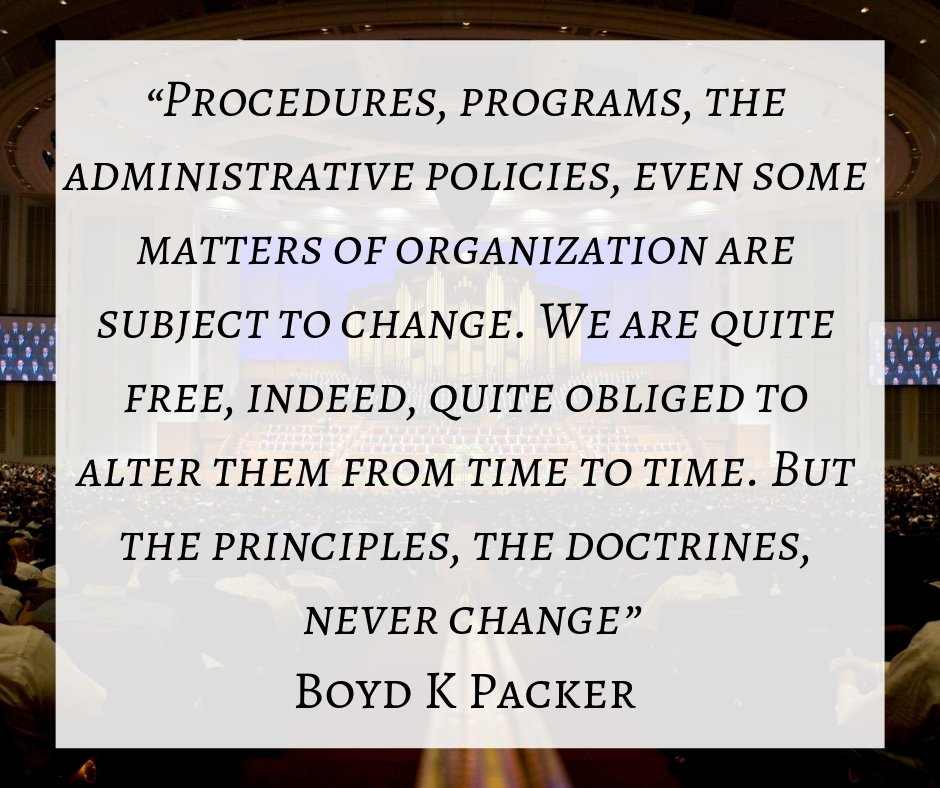
Boyd K Packer (“Principles,” Ensign, Mar. 1985, 8).
If you like this article, you will also love "Why Policy Reversals Should Strengthen Your Testimony."




I can't see 8-year-olds in the temple. The temple is the epitome of the priesthood, and the boys should be of priesthood age, with the girls of corresponding age. I think that's an important point. Boys below 12 are not ordained for a reason. I don't think they're mature enough to hold the priesthood yet or understand its responsibilities.
I know many 8-year-olds that are more mature than 12-year-olds. I think that the gap between baptism and ordination could easily be eliminated as I see it serving no purpose.
On the whole 8 years olds are not as mature and as knowledgeable as a 12 year old. I agree that one should be old enough to understand the responsibilities of the priesthood. The Temple is difficult for even some adults to understand. From what I have seen in Sunday School classes it is difficult for even 12 year olds to keep their attention on the topic at hand. No matter each of our opinions, it will be the Lord that will decide this in his due time. We need to have faith in our Prophet and in the Lord to guide us.
I work in the baptistry in the Manti temple, and this change to allow women to witness has been so helpful in allowing the sisters to feel more like an important part of the ordinance. As a worker in the past all I could do to include the women was to offer them a mop or a position to give out towels. Does that need to be done? Yes, but as a person who is working in the baptistry I can see their eyes light up when instead of me handing them a pair of clogs and a mop, they walk up the stairs to sit in the witness chairs to become a real part of the ordinance. I love mopping and getting clothes and cleaning and giving out towels... it's part of my job to do so. And, the women who come with the group willingly do these things also, but when asked to witness, that's a different thing and they are confirmed in their essential part in the ordinance. It was a great change to include them!