
The Word That Does Not Exist In The Gospel.
There is a word and a concept that most Latter-day Saints believe in, but it does not exist within the gospel. Not only does it not exist, but the very concept is a lie that is damaging the Church from within. What word am I talking about? Retirement. Retirement is dangerous for three main reasons, it promotes career over covenants, the idea we deserve a break, and dethrones work.
Dieter F. Uchtdorf ("Two Principles for Any Economy" Oct 2009)
1st. Career over covenant.
Are you afraid to talk about the gospel at work? Would you share the gospel even if it cost your job? Would you change jobs/professions if your calling required it? In the early days of the church, each of these questions would have quick and resounding answers. Church history is full of men like Robert Gardner Jr, John Tanner, John Rowe Moyle, Peter Neilson, and John Benbow. These men answered these questions! They sacrificed everything, one might even say they consecrated everything, to build the temples, tabernacles, and to serve missions to build up the kingdom.
But, over time, as we have bought into the notion of retirement, we have also grown more hesitant with living our covenants. If it is not convenient for our careers then we justify not being valiant. We base our availability to God around our temporal commitments. We justify turning down callings, or not magnifying them due to our work, rather than arranging our life around His work.
President Russell M. Nelson is a perfect example of choosing covenant over career. In 1964, then Elder’s Spencer W. Kimball and LeGrand Richards of the Quorum of the Twelve Apostles were reorganizing a Stake Presidency in Salt Lake City. As usual, they met with various Stake leaders asking for recommendations on who to interview to be the next Stake President. Repeatedly the name ‘Russell M. Nelson’ came up, but repeatedly they were also told, “But he is too busy with his career.” or “He is at the height of his career being a heart surgeon.” So they passed by him.
But Elder’s Kimball and Richards kept feeling like they needed to interview Russell M. Nelson and that he should be the Stake President. So they called him into the office and they explained that they knew who he was and that he was in the height of his career as a heart surgeon, and if he was too busy they understood. And within that context, they asked him if he would be willing to serve as the Stake President. Russell M. Nelson replied, “I already made this decision in 1945 when I was endowed. I will keep my covenants to consecrate my time and talents unto the Lord. If I need to find a new career to serve, I will.”
President Nelson was willing to give up everything to be a stake President. 20 years later, in 1984, still at the height of his career, President Nelson was called to serve as an apostle. This time he did give up his career to serve.
Elder Robert C. Gay
2nd. The idea we deserve a break.
The second dangerous idea that retirement brings is the notion that we deserve a break. I was oblivious of this lurking danger until I served a mission in New England. My first area was Sharon Vermont. I was blessed to have six Sr Couples in that area. The Schucks, Charchenkos, Fishers, Starlys, Petersons, Vernons. These faithful couples balked at the idea of needing a break when life said to rest, they accepted the call to serve.
After Vermont, I went to Maine and I ran into something that shocked me. Wards and Branches that were full of less active High Priests. These men had served faithfully in the church, over decades they held various callings ranging from Stake High Councilor, to Seminary teacher, to even members of Bishoprics, including someone who was currently less active and in the Bishopric still!
What did all of these previously faithful couples have in common? Well, besides the fact they had let their daily habits of discipleship slip (prayer and scripture study), they had retired and felt that they 'deserved a break.' A break not only from their career but also, their gospel service. I was told that once the summer RV season was over that the member of the Bishopric would return to church! The others? They simply told me that they had retired and were just taking a break, or that they had put their time and effort in.
Whereas these cases are the extremes, they illustrate how an idea that we deserve a rest that that can creep into our culture and personal beliefs. In the Gospel, we don't believe in enduring to our retirement, but rather enduring to the end. Of course, we should not run faster than we have strength, but we should never stop running.
President Eyring addresses this issue in April 2010 conference when he related the following: "When I find myself drawn away from my priesthood duties by other interests and when my body begs for rest, I give to myself this rallying cry: 'Remember Him.' … whenever I am tempted to feel that I have finished some hard task in His service and deserve a rest. The Savior’s example gives me courage to press on." Henry B. Eyring ("Act in All Diligence" April 2010)
Dieter F. Uchtdorf
3rd. It Dethrones Work
When Adam and Eve were expelled from the Garden of Eden the Lord cursed Adam and his seed: "By the sweat of thy face shalt thou eat bread, until thou shalt return unto the ground—for thou shalt surely die—for out of it wast thou taken: for dust thou wast, and unto dust shalt thou return." Moses 45
For almost all of human history it has been required that you work until you physically could not work anymore, and then you would die. This is as God commanded and as His Plan details. It is a false plan by Satan that one should not have to labor for his bread. The notion of being wise with your talents and having enough to not live hand to mouth is not what is false, the notion that you deserve to stop working at 65 regardless of if you were wise steward is where the danger lies.
Fallen human nature is that we desire not to labor for our bread. We would rather someone just give it to us. We see this today with the rise of socialism in the world and politics. The masses love the idea of glutting themselves on the labor of others. Government Programs designed to take care of you from cradle to grave seek to nullify the command to work for our bread.
What's worse, many are selling themselves, their children, and grandchildren into slavery to debt and big government in the hopes of a promised retirement from the requirements of life. They seek to live free from worry or care and by the sweat of others. They become wards of the state and sell their vote for their entitlements.
The consecrated life.
Ultimately, the reason that retirement is dangerous, is because it contradicts our temple covenant to live the law of consecration. Elder Dieter F. Uchtdorf expanded this when he taught: "Retirement is not part of the Lord’s plan of happiness. There is no sabbatical or retirement program from priesthood responsibilities—regardless of age or physical capacity. While the phrase “been there, done that” may work as an excuse to avoid skateboarding, decline the invitation for a motorbike ride, or bypass the spicy curry at the buffet, it is not an acceptable excuse for avoiding covenant responsibilities to consecrate our time, talents, and resources in the work of the kingdom of God." ("Two Principles for Any Economy" Oct 2009)
The Lord expects us to keep our covenant to consecrate ourselves to Him and His work. I am not suggesting that we all quit our jobs, or that being wise stewards of what the Lord has given us is bad. Rather, I am suggesting that we refocus our lives on our covenants. As we focus on Christ, His work, and ultimate our covenant to do all things to help bring to pass His work and His glory, the windows of heaven will be opened to us. This is what Jacob was eluding to when he taught:
18 But before ye seek for riches, seek ye for the kingdom of God.
Jacob 2:18-19
19 And after ye have obtained a hope in Christ ye shall obtain riches, if ye seek them; and ye will seek them for the intent to do good—to clothe the naked, and to feed the hungry, and to liberate the captive, and administer relief to the sick and the afflicted.
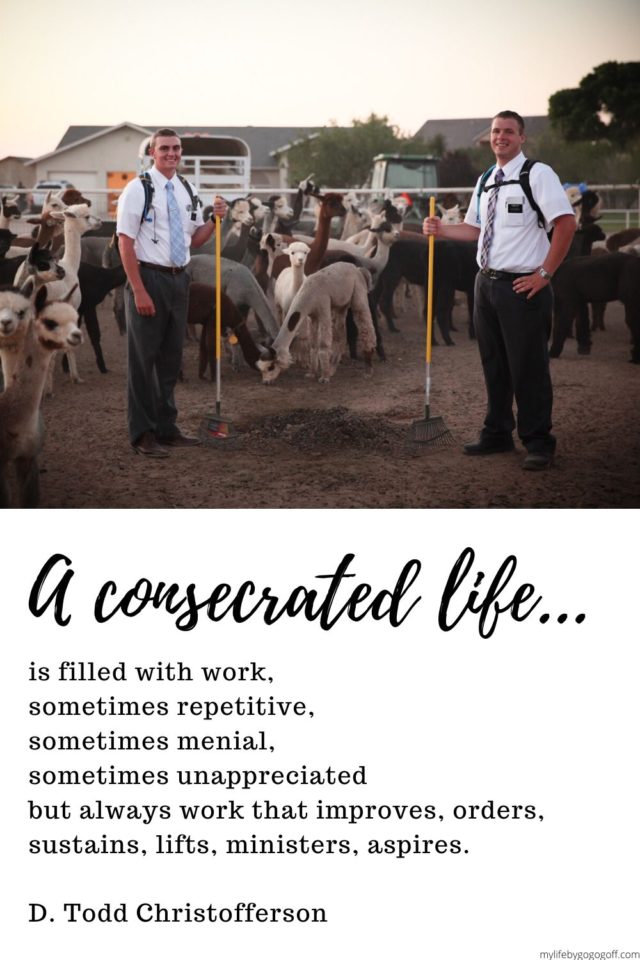
Elder Christofferson gave an amazing talk on this subject where he outlined that we will always need to work, he said: "A consecrated life is filled with work, sometimes repetitive, sometimes menial, sometimes unappreciated but always work that improves, orders, sustains, lifts, ministers, aspires."
D. Todd Christofferson ("Reflections on a Consecrated Life" Oct 2010)

I am 71 and still haven't retired from my job. I will likely work for at least 2 more years at my vocation. But my health has been declining and it will be interesting to see how much longer I can work. I told my wife that my intention upon retirement has always been to serve a mission with her, work in the temple, and do community service. Much of that cannot happen until I retire from work. So I feel caught between trying to save enough to retire and wanting to do righteous things that require quitting my job.
We have different circumstances in life. Some can't do it because of health issues. Who we are to judge them because they can't serve in the church and we can judge them unworthy? I thought the teachings of Jesus Christ of Latter-day is Judge not that ye be not judge. Only God can judge us not even the apostles.
I am not judging people Salve, but the notion of retirement is not a gospel principle. We are to endure to the end of our lives, not of our working profession.
@Salve Reginald,
The Joseph Smith translation of Matthew 7:2 reads, "Judge not unrighteously, that ye be not judged; but judge righteous judgment." While it generally inappropriate to pass judgment on others, it is important for each of us to understand gospel principles and apply those principles to our individual situations. Everyone who has made covenants with God should be willing to serve Him in whatever capacity they are called, provided that they are capable of such service. Most people with health limitations can still serve in the church. My aunt, who was nonambulatory for decades as a result of MS, was asked to call each Primary child on his or her birthday. I also know of a stake patriarch who was a quadriplegic, but was still able to give patriarchal blessings by having someone else place his hands on the head of the person receiving the blessing. "... with God all things are possible." Matthew 19:26