
Why do Latter-day Saints Not Use The Cross Yet Maintain They Are Christian?
One of the first things other Christians notice about Latter-day Saint temples, chapels, bibles, and members is the cross is nowhere to be seen. This raises the question: if we do not use the cross, are we really Christian? To that inquiry, we unequivocally proclaim that we are Christian. To which they then almost always reply, "Then why do Latter-day Saints not use the cross?" This article is meant to answer that question.
The cross, the fish, and the XP monogram of Christ.
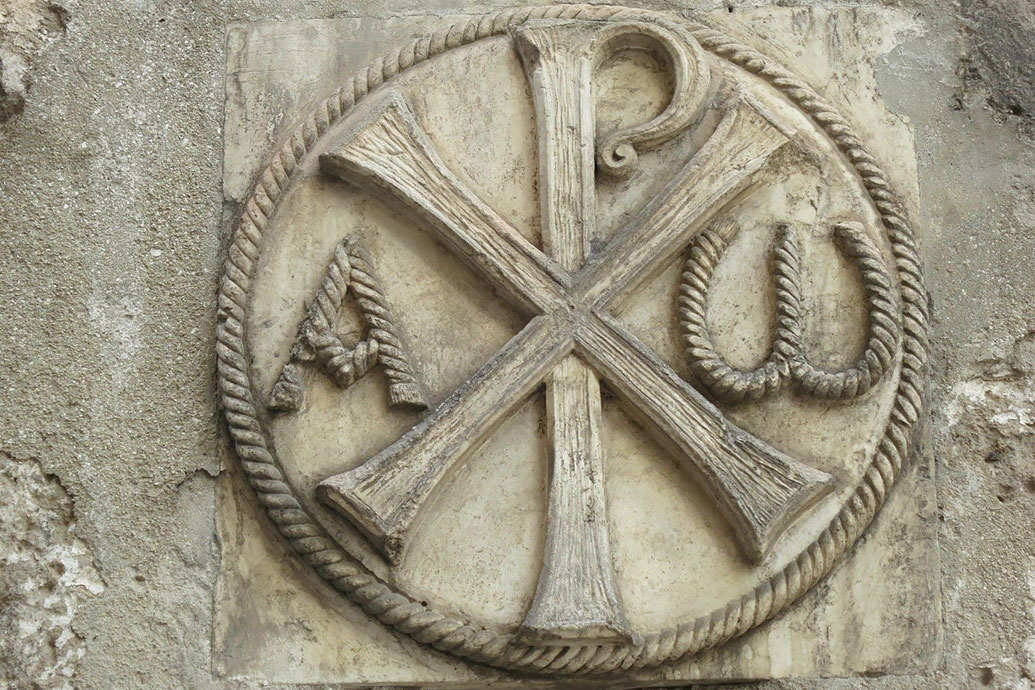
Before you can even go into why Latter-day Saints don't use the cross, it is important to realize that whereas in Western Christianity the Cross is a universal symbol of Christ, the cross became a symbol of Christianity nearly 400 years after the death of Christ. Prior to the cross, Ichthus (commonly called the Jesus fish or the Fish) and the XP monogram of Christ were popular symbols.
Ichthus or the Fish
Ichthus or the Fish was one of the first symbols of Christianity. It came into popularity because of persecution against Christians by the Romans after the death of the Apostles. Because fish were used as a symbol in paganism as well, its use would not raise suspicions with the Romans. Christians used it to designate places of worship and tombs.
It also became an easy way for a Christian to say they are a Christian without outwardly saying "I am a Christian." If two people were talking one of them would make half the fish symbol in the ground with their foot by drawing a wide ◠ mark. The other person if they were not a Christian would think they were weird or not notice, but if they were also a Christian they would see the first half of the fish and then complete the fish with the same motion. Once the person was authenticated as a true fellow Christian they were free to talk.

The XP monogram of Christ
The symbol that replaced the fish was the XP monogram of Christ. It was popularized by Constantine who in a dream saw the symbol on a banner and when he woke up instructed his men to immediately use it. Under this banner, his troops were led to victory in battle and then it became the symbol of his rule in the Roman Empire. Unlike the fish, it was a distinctively Christian symbol incorporating Greek letters that make up the names of Christ (X and P) as well as the symbols of Alpha and Omega which were titles of Christ. Under Constantine, Christians were no longer persecuted by the authorities, and the fish all but became obsolete until a revival of the symbol in the late 1900s by modern Christian groups.
The Cross
In the 2nd century, Christians started using the Cross as a symbol of their faith, but it was not until Constantine in the 4th century that it became mainstream. There are MANY variations of the cross used by different Christian denominations around the world. Many Christian churches distinguished themselves by their different crosses. It allowed people to know what denomination of Christianity a cathedral or person was by simply looking at it. Six of the most popular crosses are seen below.

Why do Latter-day Saints not use the cross?
With that context and history, we can now address the question at hand. Why don't Latter-day Saints use the Cross? There are three main reasons.
1st. It is a post-apostolic symbol.
As I've already pointed out, historically, the cross was a post-apostolic symbol of Christ. IE, a symbol that came into Christianity after the death of the apostles (2nd century) and was not fully adopted by Christianity until the 4th century! A core aspect of Latter-day Saint theology is a belief in a great apostasy after the death of the apostles. In a nutshell, this means that we believe that Christianity lost the authority held by the apostles to direct the church, and as a result, false doctrines and practices crept in, and the church fell away. The epistles of the New Testament themselves are addressing the apostasy that was already underway before the apostles died. We believe that the restoration of the gospel was to bring back all that was lost and restore it to the truths that the apostles taught, and the apostolic authority.
The cross came about after the apostasy. The very fact there are hundreds of iterations for all the splitter denominations is self-evident that the cross is a symbol of a broken and disunified Christianity. Therefore, as a restoration of Apostolic Christianity, it would make no sense to adopt a symbol of the very apostasy that the restoration is correcting.
2nd. Worshiping the cross.
For most Christians, the cross is a symbol of their faith. Seeing a cross draws their minds to the crucifixion and to Christ. But as early as the 2nd century when crosses were first adopted as a symbol of faith, the accusation arose that for some, it became the object of their worship. For a small minority, it became an idol, they prayed to the cross, they sang about the cross, and they worshipped the cross.
Now, in a spirit of full disclosure, even Latter-day Saints struggle with focusing on an aspect of Christ rather than Jesus Christ. Russell M. Nelson addressed how Latter-day Saints had drifted in their worship when he taught: "It is doctrinally incomplete to speak of the Lord’s atoning sacrifice by shortcut phrases, such as 'the Atonement' or 'the enabling power of the Atonement' or 'applying the Atonement' or 'being strengthened by the Atonement.' These expressions present a real risk of misdirecting faith by treating the event as if it had living existence and capabilities independent of our Heavenly Father and His Son, Jesus Christ."
When I first heard that quote in general conference it really hit me, am I focusing on an event, aspect, or symbol of Christ rather than the Living Christ? I turned on the radio and the song Flawless by MercyMe was playing and I heard the lyrics: "No matter the hurt, Or how deep the wound is, No matter the pain, Still the truth is, The cross has made, The cross has made you flawless."
It was exactly what President Nelson was talking about! The Christ, not the cross should be our focus! And whereas for many, if not most, Christians and Latter-day Saints, the focus is Christ, for some, the focus has become the symbol.
3rd. A symbol of the dying Christ.
The third and final reason why Latter-day Saints do not use the cross to adorn our temples, chapels, homes, and bibles is that the cross is a symbol of the dying Christ. Gordon B. Hinckley taught, “I do not wish to give offense to any of my Christian colleagues who use the cross on the steeples of their cathedrals and at the altars of their chapels, who wear it on their vestments and imprint it on their books and other literature. But for us, the cross is the symbol of the dying Christ, while our message is a declaration of the Living Christ.”
For Latter-day Saints, the cross as a symbol of Jesus Christ is wholly inadequate for our doctrine regarding His role. Whereas yes, we believe that He died on the cross, we do not view that as the apex of His life. We believe that His death was the darkest hour of humanity. An hour in which humanity rejected God and crucified Him. The cross is a symbol of His death. Imagine if your favorite team was playing for the gold medal. Imagine if at halftime the score was 7-21, they go on to defy all odds and win the game. But your mom frames the halftime score. The death of Christ is not what we celebrate, it is the living Christ.
Latter-day Saint Symbols of Christ.
If we do not use the cross because of the above reasons, then do we use any symbols for Christ? Yes! We absolutely have symbols of Christ. I want to touch on just three of them quickly.
1st. Temples.
One of the most iconic symbols in The Church of Jesus Christ of Latter-day Saints is the temples that we build. Each temple is a symbol of Christ. It is a testimony that we believe that Christ's promise of a resurrection is real. Like the cross draws the minds of Christians to Christ and the crucifixion, the temple draws the minds of Latter-day Saints to the entirety of the Plan of Salvation and the role of Jesus Christ as our Lord and Savior.
2nd. The Christus.
Just as you might never see a cross in a Latter-day Saint home or on one of our temples, there is a good chance you will see a replica of the Christus statue of the resurrected Jesus by Bertel Thorvaldsen. As a Church, it was adopted due to the focus on the Living nature of Christ as a symbol of our faith. Many of our temples have visitor centers with replicas of the statue, with the Rome Temple even having statues of all Twelve Apostles surrounding Christ just as the original Christus statue has in Copenhagen. In 2020, the Church adopted a depiction of the Christus as our official logo.
Emphasizes the Centrality
of the Savior
3rd. The lives of our members.
The final, and most important symbol of Christ is discipleship. It is our lives if we are following Him. It is His light reflected in our countenance. Gordon B. Hinckley taught, "The lives of our people must become the most meaningful expression of our faith and, in fact, therefore, the symbol of our worship."
Crosses, temples, paintings, statutes, and even scriptures pale in comparison to the powerful symbol of Christ which is lifelong devoted discipleship. The highest and holiest symbol of Christ in The Church of Jesus Christ of Latter-day Saints is when each of us takes upon ourselves His name in the water of baptism and then seeks to "bear one another’s burdens, that they may be light; yea, and are willing to mourn with those that mourn; yea, and comfort those that stand in need of comfort, and to stand as witnesses of God at all times and in all things, and in all places that ye may be in, even until death." (See Mosiah 18:8-9)
How we act is the true symbol of our faith.
Just as sitting in a garage does not make someone a car, nor does wearing a cross or going to Church make someone a Christian. Our actions are ultimately what defines us as true Christians. Not what we adorn our buildings with (Crosses), not what we paint on our foreheads (Ash Wednesday), not what books of scripture we do or don't read, and not where we go to Church on Sunday, or even if we go on Sunday or Saturday! The test of a true Christian is in our response to His invitation to lifelong discipleship of "Come, follow Me."
If you liked this article you will like "Do Latter-day Saints believe in Palm Sunday and Holy Week?"

John Hilton III has written an excellent book 'Considering the Cross'. I recommend it as further reading because he delves a great deal into the history of the use of the cross as well as how the early saints used the cross (it was on one of the first copies of the book of Commandments.) I also thought I saw a cross on the Widstoe Foundation icon. There are no LDS policies or doctrine against the use of the cross.
Early Saints also believed in the trinity. Just because it was something early saints did does not mean it is right. The restoration is ongoing. I quoted President Hinckley regarding the Cross his words trump early practices or books from members.
I'm a mormon and I wear a cross, but I think this explanation demonstrates just how far removed Mormons are from christianity, it's a bit arrogant as well since we represent a fraction of 1% of al christianity. I have been all around the world and have found that the cross is Christ, it's the most symbolic representation of Christ in the world, there are billions of Christians around the world that use this symbol to testify of their belief in Christ. There isn't another symbol in the world that has more meaning for people, it's incredible if you think about it. It's a bit ignorant of "Mormons" who represent the smallest fraction of christianity to not wear the cross, or to speak of why we shouldn't wear the cross. There are people that literally in certain parts of the world are killed for wearing the cross, if that's not the very definition of taking up your cross and following Christ I don't know what is. Think about that for a minute, how many mormons would be willing to wear a symbol that could take their life? And yet we have the audacity to talk about why we don't wear the cross?? We should. The reality is that the mormon church is just trying to differentiate itself, that's it. But it's really unfortunate that they distance themselves from the most important symbol this earth has ever seen.
Hello Trevor,
First, it does not matter what apostate Christianity does or what symbols they use, we are not obligated to follow the post-apostolic practices of the apostasy. We are a restoration and the first generation saints did NOT use the cross.
Second, the name of the Church is The Church of Jesus Christ of Latter-day Saints, not 'Mormons' or 'the Mormon church.'
Third, regardless of what percentage of Christianity we represent we hold the entirety of apostolic priesthood authority. Therefore, when a man who holds apostolic keys, that NO OTHER CHURCH HAS, President Gordon B. Hinckley, declares we do not wear the cross and gives the reasons he holds more weight than the traditions of men.
Forth, are you really a member of the Church if you are questioning if we are willing to die for Christ? Do you not know the history of our Church???
The cross is NOT the most important symbol the earth has ever seen. The living Christ is, and I think that is the root of your issues, everything you've said is rooted in a dead Christ and what dead Christianity does.
@Jeremy,
@Trevor,
I’ve always remembered it in this way. If a member of your family was shot with a gun would you wear it around your neck to remember them? The dying on the cross was the way he died along with two other men. It was not where he paid for all of our sins that was done in Gethsemane. It was just his execution. No different than any other means criminals were put to death back then. Even though he had no sin.
I invite you to watch the 2022 BYU Easter Conference--https://www.youtube.com/watch?v=HMrhZV7iNoM. Dying on the cross was definitely part of the Atonement of Jesus Christ.
No one said dying on the Cross was not part of the Atonement of Jesus Christ,it obviously is.
@Trevor, I also wear a cross. I wear an Angel Moroni with it. To me an empty cross is a symbol of Christ’s victory over death. To me it also symbolizes my family’s journey here, to America, to find religious freedom. I couple it with the Angel Moroni to signify my conversion to the Church of Jesus Christ of Latter-day Saints, the end of a journey my family started in 1635, coming to America.
@Trevor, I don't think our Latter-day Saints is ignorant because other churches uses the cross. But consider that we are very different from them in our belief and doctrine. So on that belief that we are very different, meaning we are unique which brings me to conclude that if other churches doing something, we shouldn't follow them. "We walk by Faith not by sight". In the name of Jesus Christ. Amen.
Because we are BELIEVE in a LIVING CHRIST.
Not a dead Christ
One thing I always mention to people is that the Cross traditionally was a symbolism of the Pagan Babylonian God Tammuz - A Sun-God in Babylonian Mythos.
Along with this, the Bible actually is not clear as to whether Christ was crucified on an actual Cross. Even the website GotQuestions mentions this. The Romans did not use one type of crucifixion as there is evidence people were crucified via an X-Shaped wooden beams, a Stake or pole (which is the Strong's use of Stauros), or even upside-down shaped cross.
The fact remains, the emblem/symbol of the Cross appears to be more revered as a form of worship rather than Christ himself. People scoff when they challenge my faith and testimony and say, "You can't be Christian because you don't have a cross in your church." To which I reply, "because I don't bow down to a Babylonian Sun God of paganism. I worship Jesus Christ who is the Son of the Living God."
I'm a Saint and as a whole we are missing the point. The "empty" cross is a symbol of everlasting life. Jesus defeated the cross. It is not the method by or a symbol of his death. Only when he is portrayed on the cross, do I think it is an image that shouldn't be used to reflect Christianity and my faith. Regardless of Apostacy, I believe it is a work of evil to not display to all the world and also to have us believe on it as some sort of anti-christian symbol, the empty cross from which the Savior defeated death. It is truly a representation of the miracle and most important gift we have been given. On this Easter celebration we all celebrated that empty cross! Amen!
SO you think it is the work of evil for the Prophets not to adorn our Temples with crosses and when asked reject the notion? It seems as if your emotions are strong on this subject. But the cross is a relic of the apostasy. We are not. The cross being empty is not a real argument as many Christian Churches have crosses with Jesus on it still.
I love the way my mother-in-law put it. If he was hung, would you wear a noose around your next and put a noose on the wall of your home?
I grew up in the United Church of Canada and a cross was not used in that church at that time. It was thought to be too Catholic. However, since that time most Protestant churches have adopted the cross as a Christian symbol. To say we are not Christian because we do not use the cross would also have to have been said about earlier Protestant Churches who did not adopt the cross until a few years ago.
In America, outside of the Catholic church, Christian churches didn't start using the cross as a symbol of their faith until the second half of the 19th century and it didn't really take off till the 1920s and 1930s. You don't have to use the symbol of the cross to be Christian.